Back to Blog
Add to Calendar Links in HubSpot Emails: Step-by-Step (2026)
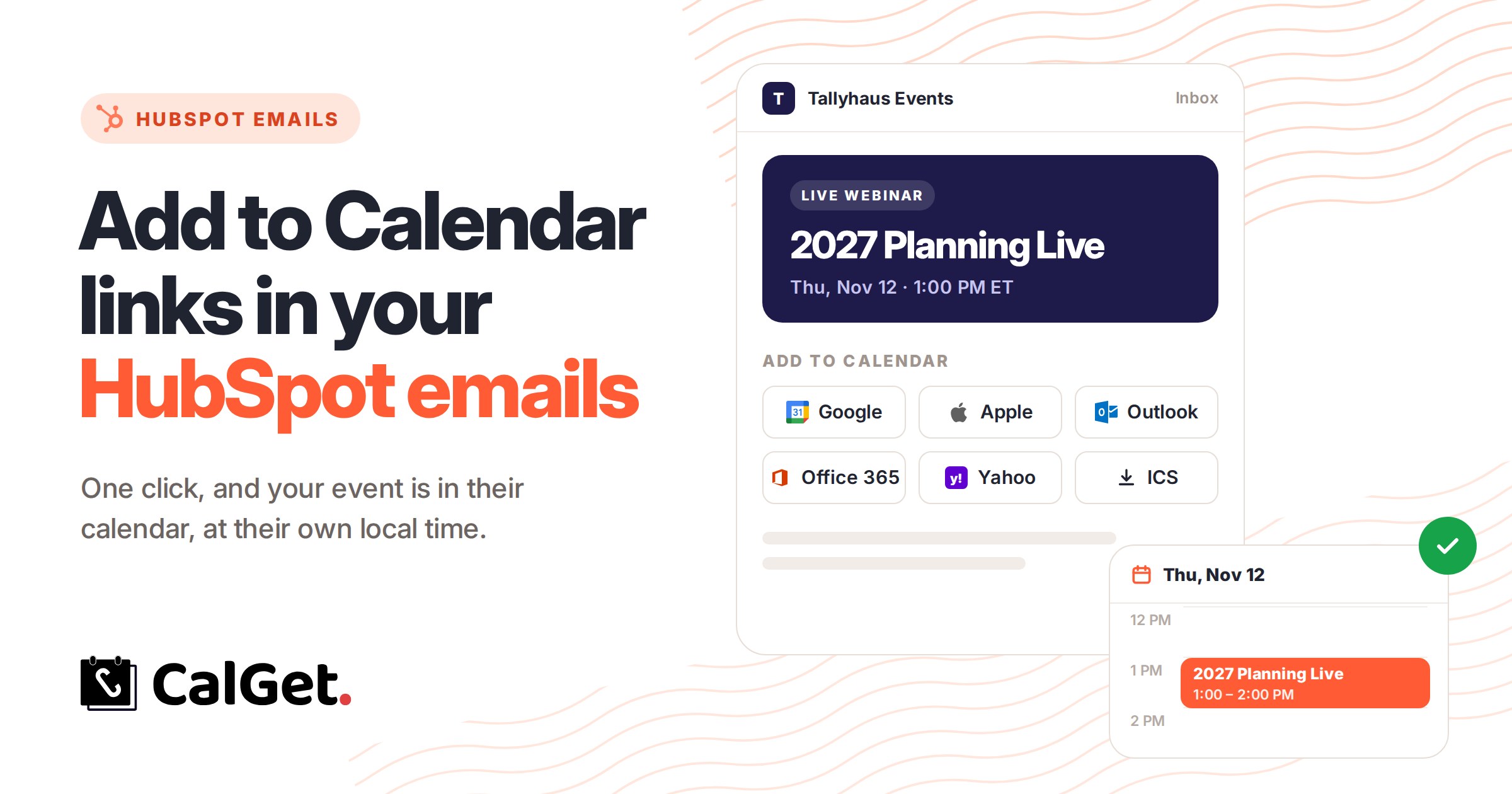
Registered isn't attending. Here's how to add Add to Calendar links to any HubSpot email, step by step: Google, Apple, Outlook, Office 365 and Yahoo buttons in an HTML module, tested, in every contact's time zone.
Written by
Last updated: October 2026. Every CalGet step and link below was tested on a real event in October 2026, and the HubSpot steps follow HubSpot's own documentation.
Quick answer
To add Add to Calendar links to a HubSpot email, create your event in CalGet (title, date, time and time zone), open it, and under HTML Code click Copy as HTML. In HubSpot's drag-and-drop email editor, drag an HTML module into your email and paste the code. Your contacts get Google, Apple, Outlook, Office 365, Yahoo and ICS buttons, each opening the event already filled in, at the right local time.
Your webinar invite goes out to 4,000 contacts on Monday. Plenty of them open it, a good number click Register, and then the week happens: back-to-back meetings, a deadline, a sick kid. By Thursday at 1 PM, your event is competing with everything already sitting in their calendar. The people who show up are mostly the ones who put it there.
An Add to Calendar link lets them do that in one click, right from your email. This guide shows you how to add Add to Calendar links to a HubSpot email, step by step, using a real webinar invite we built: what to set up in CalGet, where to paste the code in HubSpot, how to test it, and why the time zone is the detail most people get wrong.
Prefer to watch? The whole setup takes about a minute on video.
What is an Add to Calendar link?
An Add to Calendar link is a link or button that opens the reader's own calendar with your event already filled in: the title, the date and time, the location and the description. One click, and the event is in their Google, Apple or Outlook calendar, with their usual reminders. It's different from a link to your event page, which shows the details but leaves saving the date up to them.
For a deeper look at how these links work, see our guide to what an Add to Calendar link is.
Why HubSpot emails need Add to Calendar links
HubSpot is great at getting your invite in front of the right people. Its email editor gives you text, images and buttons, and a button can take people to your registration or event page. What it doesn't do on its own is put the event in their calendar.
| Link to your event page | Add to Calendar links | |
|---|---|---|
| What the click does | Opens a web page | Opens their calendar with the event filled in |
| Saved for later | Only if they do it themselves | Yes, in one click |
| Reminders | None | Their calendar's usual reminders |
| Time zone | They work it out | Shown in their own local time |
| Calendars | n/a | Google, Apple, Outlook, Office 365, Yahoo, plus an ICS file |
You don't have to choose. Keep your Register or View the agenda button, and add the calendar buttons right under the event details.
How to add Add to Calendar links to a HubSpot email
Here's the whole process at a glance. Each step is explained below.
- 1Create the event in CalGet: title, time zone, date and time, location, description.
- 2Create Event Link, then open the event.
- 3Copy the buttons as HTML (HTML Code → pick a design → Copy as HTML).
- 4In HubSpot, open your marketing email in the drag-and-drop editor.
- 5Drag an HTML module under your event details and paste the code.
- 6Preview and test on desktop and mobile, then send.
Step 1: Create your event in CalGet
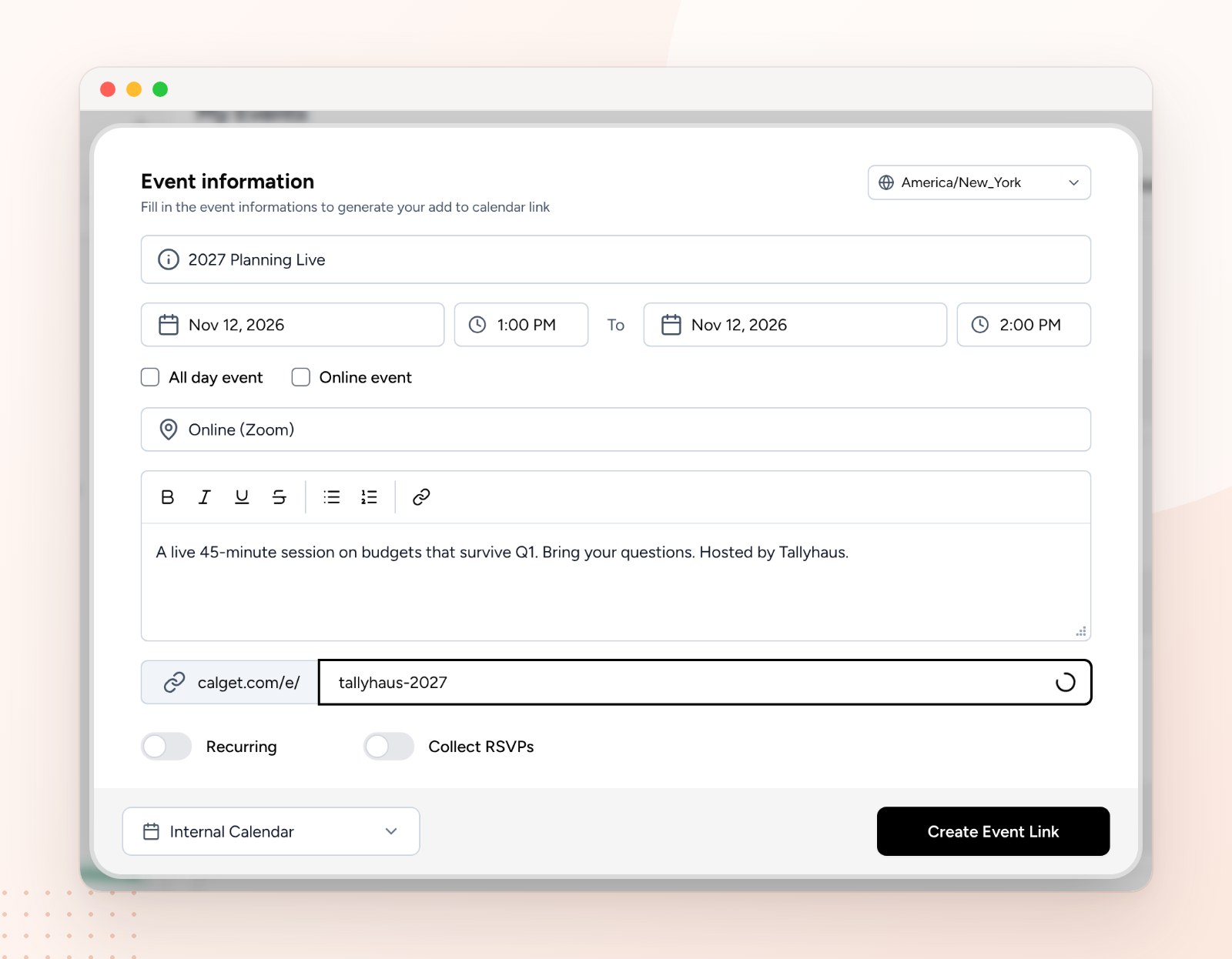
In CalGet, click New Event. Add the title, then check the time zone at the top right of the form: it should be the time zone the event happens in (ours is America/New_York). Then set the date and time, where it happens ("Online (Zoom)" for a webinar) and a short description. The description is what people see when they open the saved event on the day, so put the essentials there.
Optionally, give the event a custom link (we used calget.com/e/tallyhaus-2027), then click Create Event Link.
Step 2: Open the event and find the HTML Code
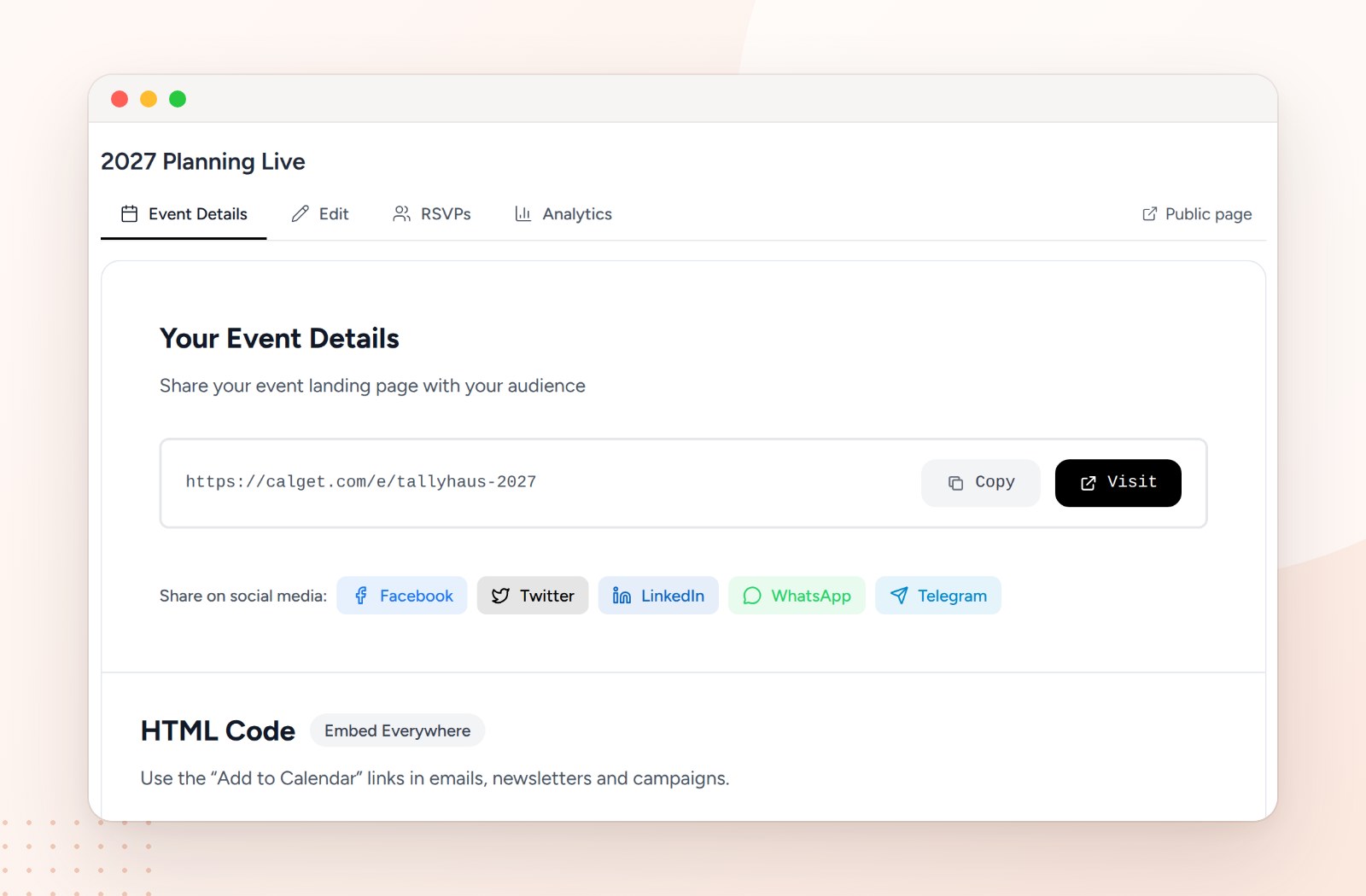
Open the event. At the top you'll see its link (your event page), and below it HTML Code, the "Add to Calendar" buttons made for emails, newsletters and campaigns.
Step 3: Pick a design and copy the buttons as HTML
Under Select Design, choose Modern, Classic, Text Only or Custom. The preview shows exactly what your contacts will see: Google, Apple, Office 365, Outlook, Yahoo and ICS. Then next to Copy as, click HTML.
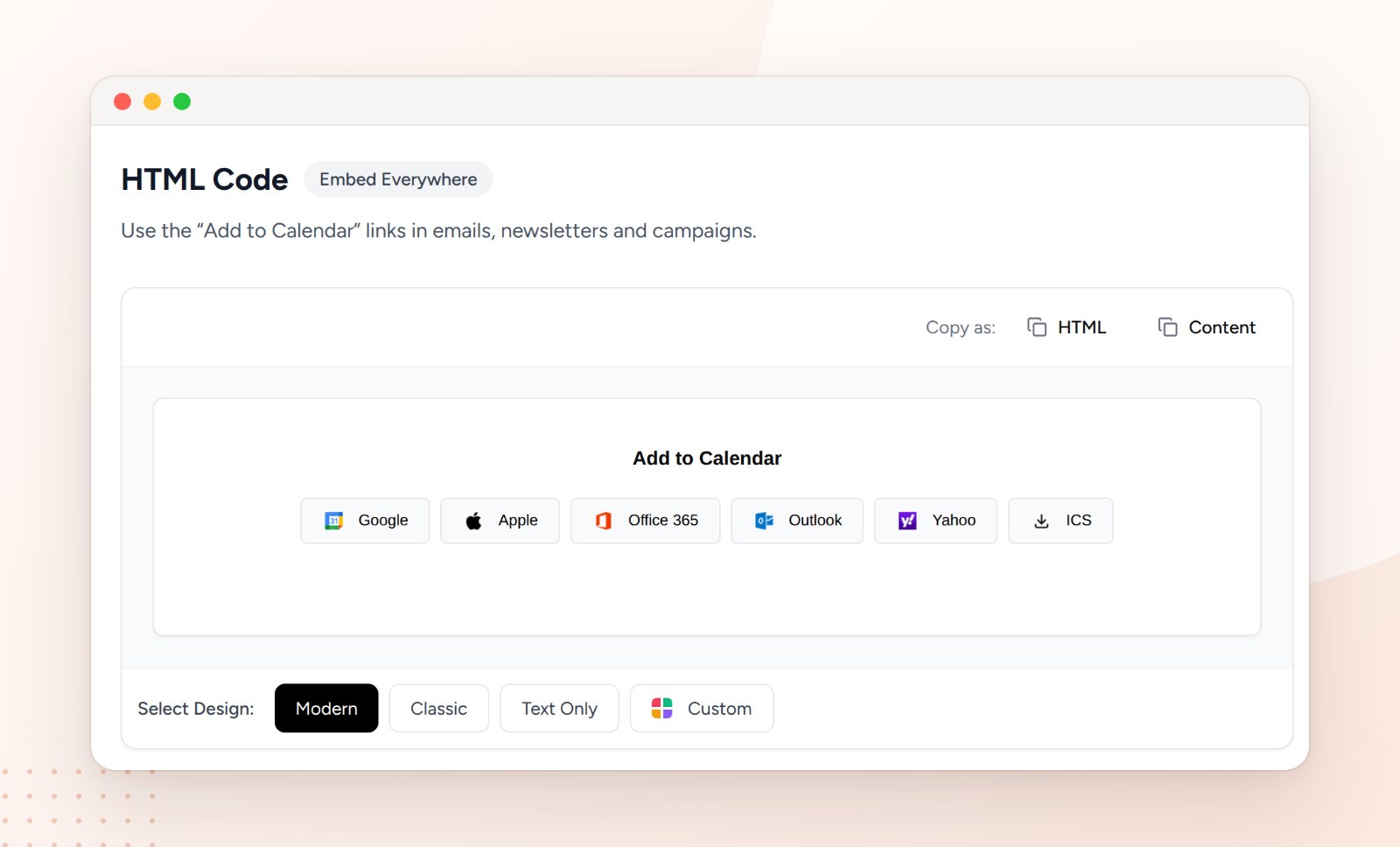
Tip: the Content option copies the buttons as formatted content instead of code, for editors where you paste into the text itself rather than into an HTML block.
Step 4: Open your email in HubSpot
In HubSpot, go to Marketing → Email and open your email in the drag-and-drop editor (HubSpot: Create and send marketing emails). Find the spot right after your event details: the date, time and what it's about. That's where people decide whether to come, so that's where the buttons belong.
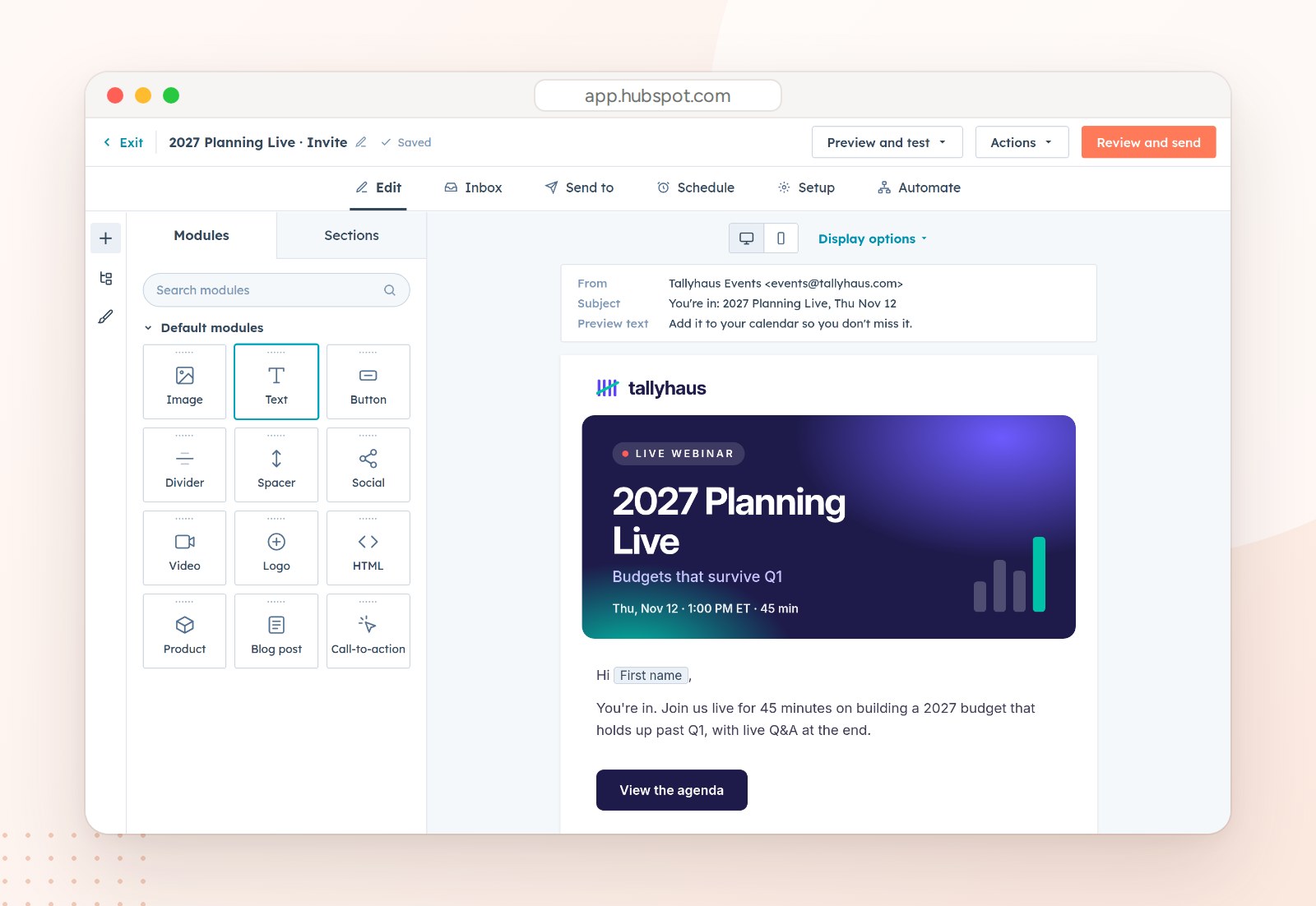
Step 5: Drag in an HTML module and paste the code
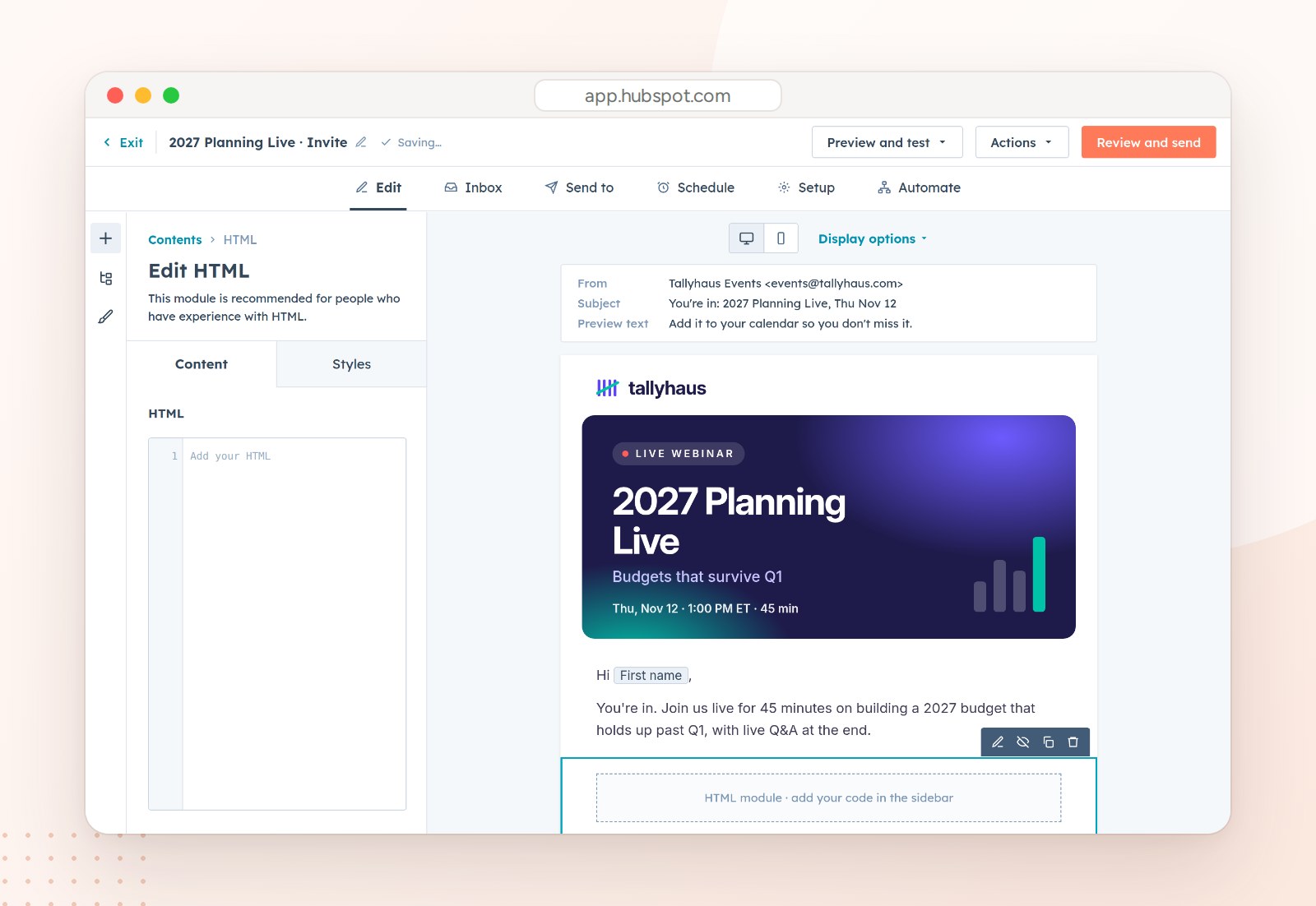
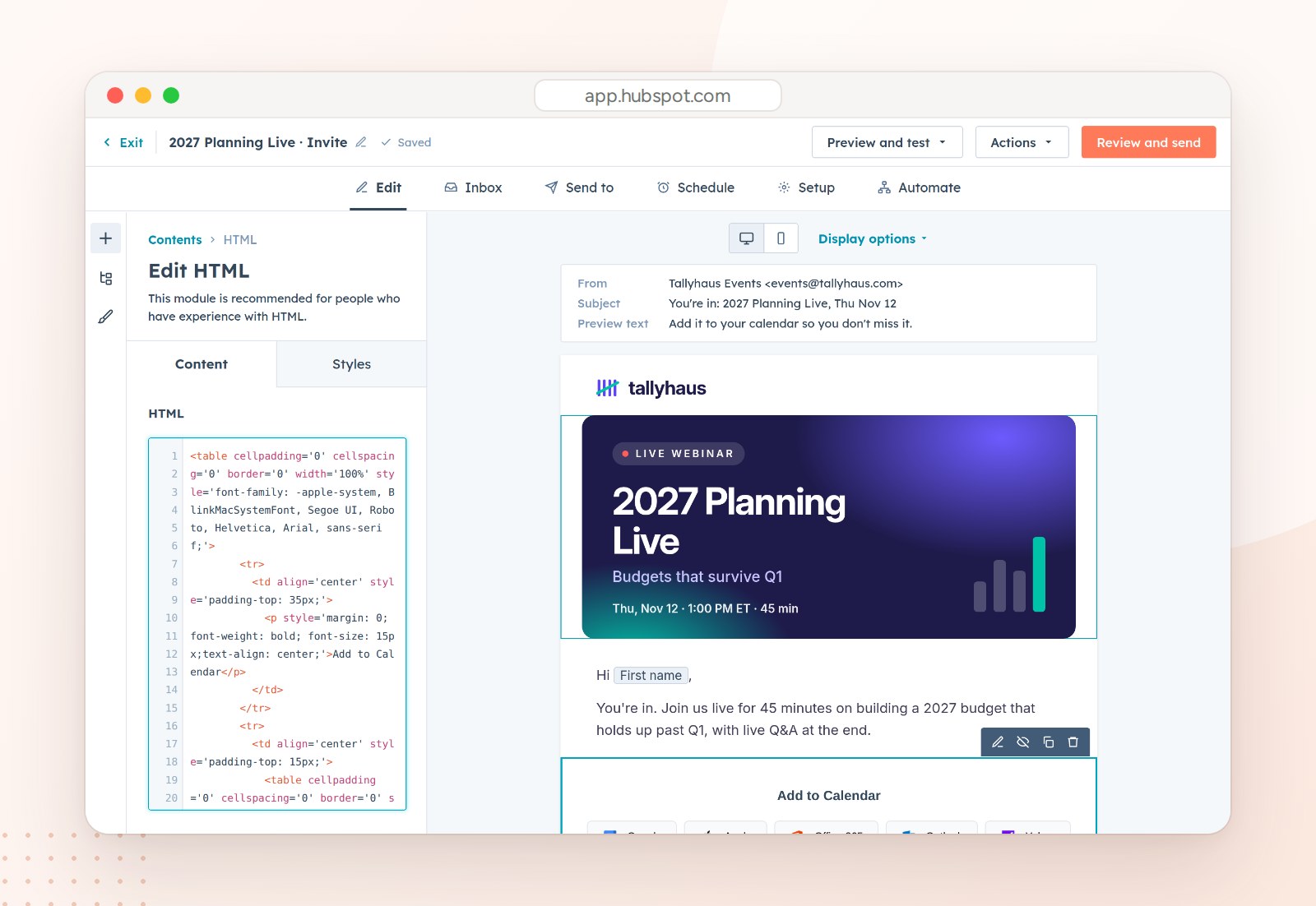
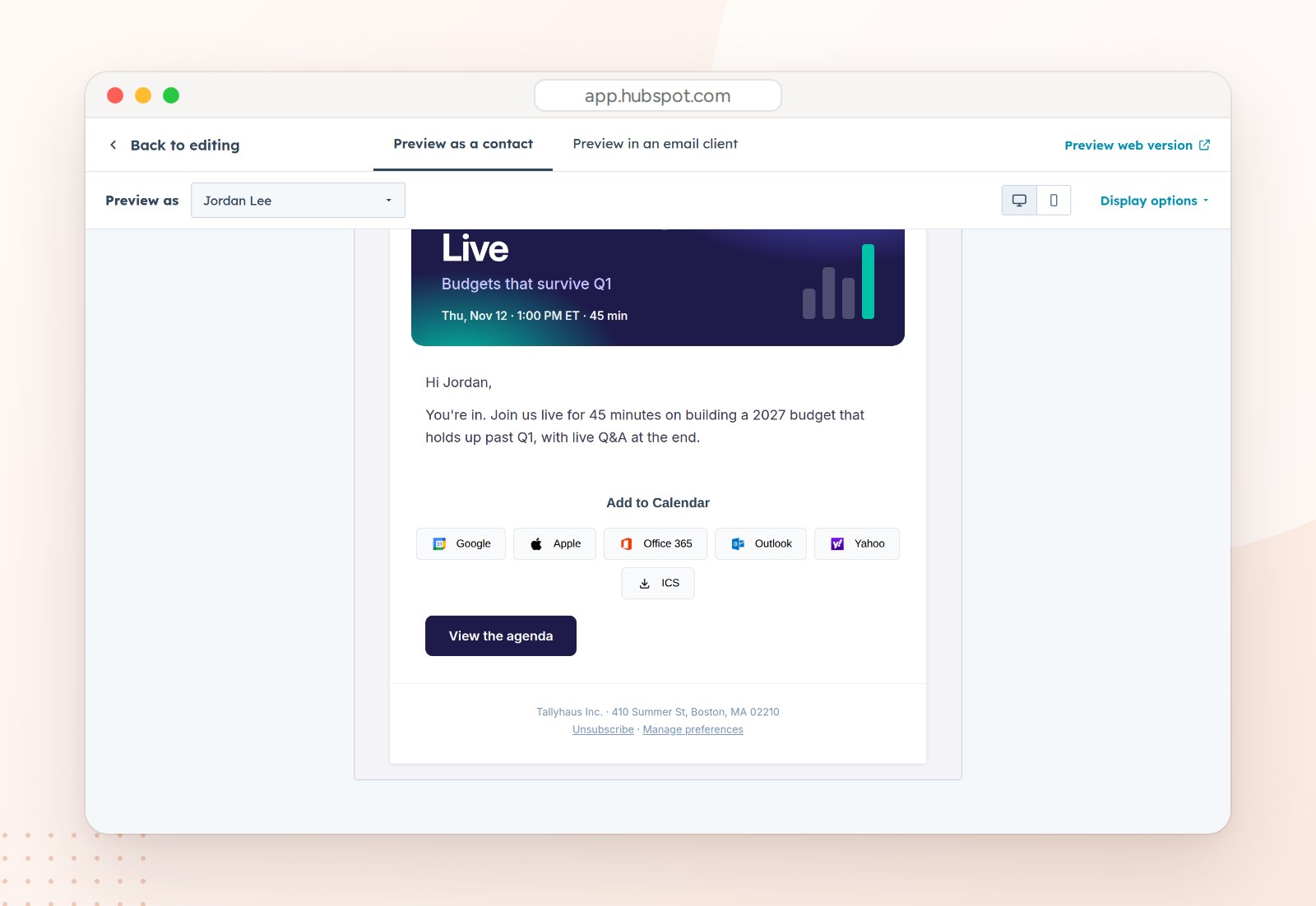
From the Modules panel, drag the HTML module into place under your event details. HubSpot describes it as a "raw HTML module for emails" (HubSpot: default email modules). Click into the HTML field and paste the code from CalGet. The buttons appear in your email right away.
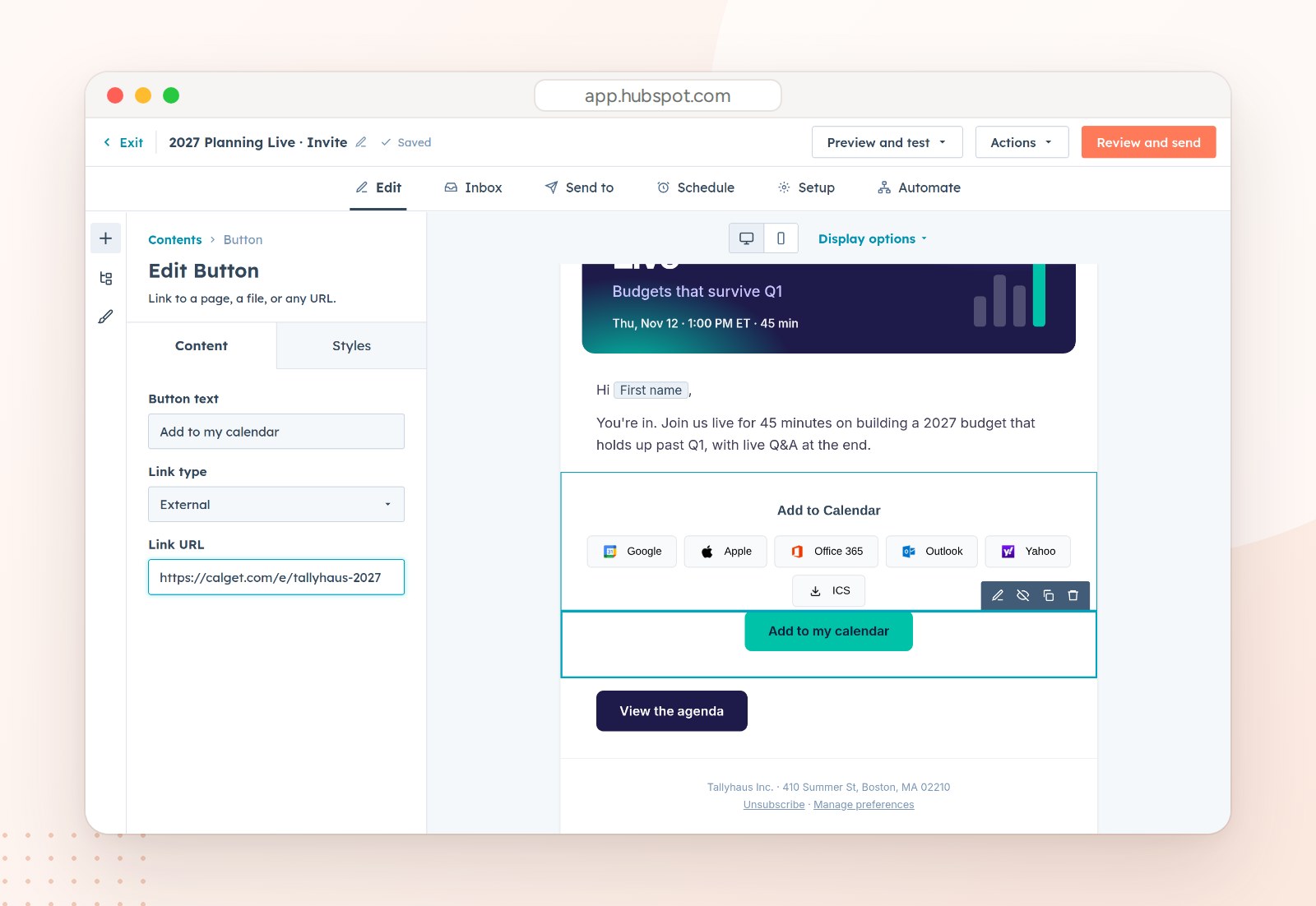
Want a single button instead? Drag in a Button module, set the text to something like "Add to my calendar", choose an external link, and paste your CalGet event link (calget.com/e/...). The button opens your event page, where people pick their calendar.
Step 6: Preview and test, then send
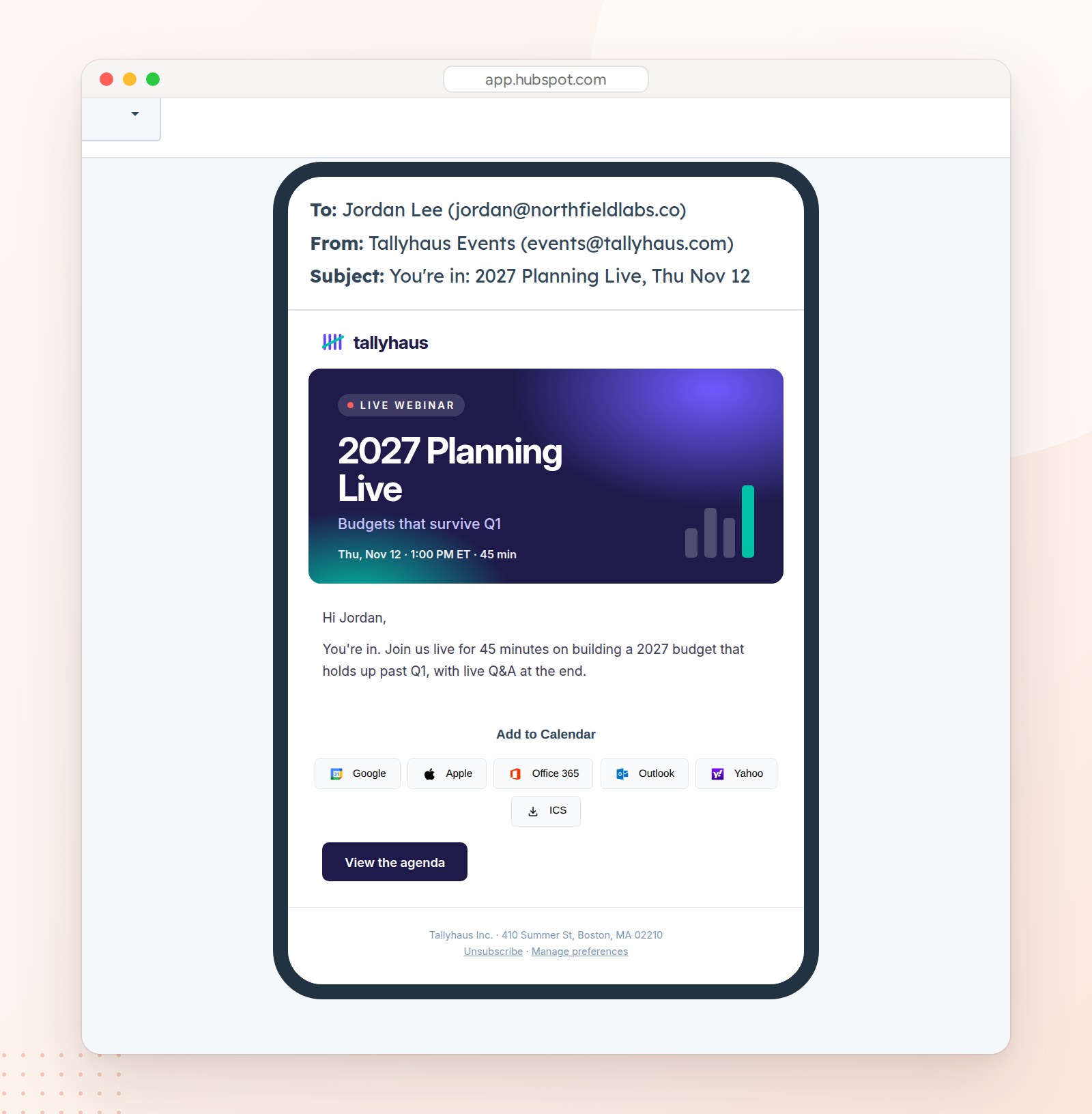
Click Preview and test. Preview the email as a contact, check the mobile view, then use Send test email to send it to yourself (HubSpot: preview and test). Open the test on your computer and your phone, and click a button or two: each one should open the event, already filled in, at the right time.
Time zones: the detail most people get wrong
If your list spans time zones, "1 PM" means three different things. Add to Calendar links handle that for you, as long as the event itself has the right time zone. We clicked every button on our event (Thursday, November 12, 2026, 1 to 2 PM New York time) and checked what each calendar receives:
| Button | What it sends | What your contact sees |
|---|---|---|
| The event with its time zone (America/New_York) | The right local time | |
| Outlook, Office 365 | The time in UTC (18:00 to 19:00) | The right local time |
| Yahoo | The time in UTC | The right local time |
| Apple, ICS | A calendar file that carries the time zone | The right local time |
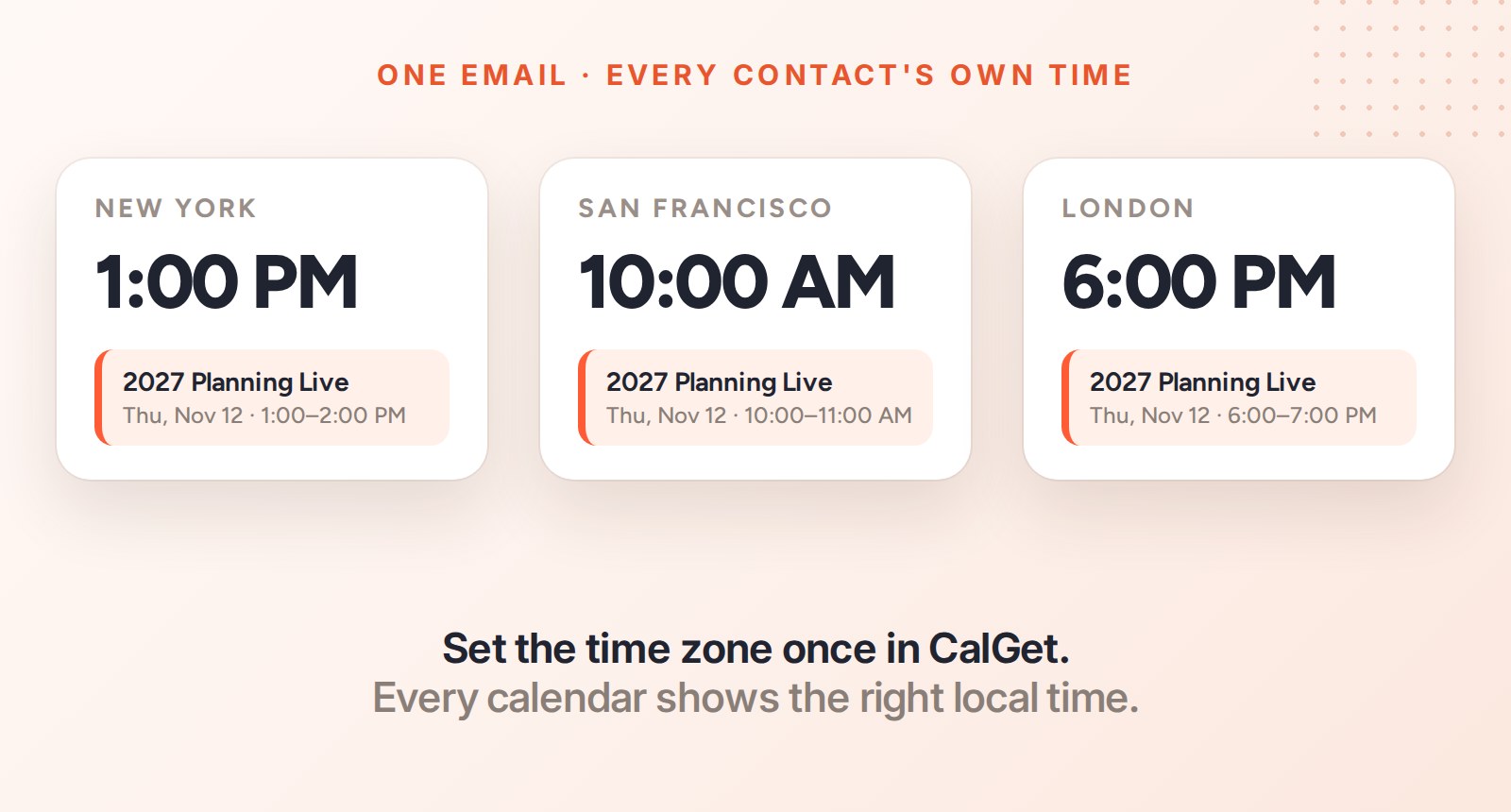
So a contact in San Francisco saves it at 10 AM, and one in London at 6 PM, from the same email. The one thing to check is the time zone on the event in CalGet before you copy the code.
Where to put Add to Calendar links in your HubSpot emails
Right after the event details. Date, time, what it is, then the buttons. People decide while those details are in front of them.
In every email about the event, not just the invite. Your registration confirmation and your reminder emails are natural places to repeat them. The same HTML works in each, and it's still the same event.
Label it plainly. CalGet's buttons already say "Add to Calendar" and name each calendar. If you use a single Button module, "Add to my calendar" says exactly what the click does.
Pair it with RSVPs when you need a headcount. If you also want to know who's coming, turn on Collect RSVPs for the event in CalGet and link the event page. Our guide on RSVP buttons in HubSpot emails walks through it.
Common mistakes (and how to fix them)
| What you see | Why | Fix |
|---|---|---|
| The code shows up as text in the email | It was pasted into a Text module | Paste it into an HTML module instead |
| The time is off for some contacts | The event's time zone in CalGet is wrong | Set the right time zone on the event, then copy the code again |
| The buttons look cramped on phones | The module is in a narrow column | Give the HTML module the full width of the email |
| A button opens the wrong event | Code copied from another event | Open the right event in CalGet and copy its HTML again |
Changed the event? The buttons link through your CalGet event, so if you update the time or description in CalGet, people who click after that get the new details. Anyone who already saved it keeps their earlier entry, so say so in your next email.
How we tested this
We created a real CalGet event, "2027 Planning Live" (Thursday, November 12, 2026, 1 to 2 PM America/New_York, online), with the custom link calget.com/e/tallyhaus-2027, copied its Add to Calendar buttons as HTML, and clicked every one of them on the live links in October 2026: Google received the event with its time zone, Outlook, Office 365 and Yahoo received UTC times, and the Apple and ICS buttons returned a calendar file. The HubSpot steps follow HubSpot's Knowledge Base and developer documentation as of October 2026.
Tallyhaus and its contacts are made up. The HubSpot editor in the screenshots and the video is a recreation based on HubSpot's documentation, so your screen may look slightly different; every CalGet screen, the button code and the links are real.
Key takeaways
- An Add to Calendar link puts your event straight into the reader's calendar, with their reminders.
- In CalGet: create the event, check its time zone, open it, and Copy as HTML under HTML Code.
- In HubSpot: drag an HTML module under your event details and paste the code.
- Prefer one button? Use a Button module that links to your CalGet event page.
- Preview and test on desktop and mobile; every calendar shows the event in the contact's own time zone.
Frequently asked questions
How do I add an Add to Calendar button to a HubSpot email?
Create your event in a tool like CalGet and copy its Add to Calendar buttons as HTML. In HubSpot's drag-and-drop email editor, drag an HTML module into your email and paste the code. Then use Preview and test to check it before you send.
Which module do I use in HubSpot for Add to Calendar links?
The HTML module, which HubSpot describes as a raw HTML module for emails. If you'd rather show one button, use a Button module and link it to your event page.
Which calendars do the links work with?
CalGet's buttons cover Google Calendar, Apple Calendar, Outlook, Office 365 and Yahoo, plus an ICS file that works with most other calendar apps.
Will contacts in other time zones see the right time?
Yes, as long as the event has the right time zone in CalGet. Google receives the event's time zone, Outlook, Office 365 and Yahoo receive the time in UTC, and the Apple and ICS file carries the time zone, so each calendar shows the contact's local time.
Can I use the same Add to Calendar links in several emails?
Yes. Copy the same HTML into your invite, confirmation and reminder emails. It's the same event, and the links keep working for every email.
What happens if I change the event after sending?
The buttons link through your CalGet event, so people who click after you update it get the new details. People who already saved the event keep their earlier entry, so mention the change in your next email.
Can I add Add to Calendar links to other email tools?
Yes. The same HTML works anywhere you can add an HTML block. We have guides for Mailchimp, Constant Contact and Outlook.
Put your next event on their calendar
Create the event once, copy the buttons, paste them into your HubSpot email. The next time you send an invite, the people who want to come will have it in their calendar.
Create your Add to Calendar link in CalGet and add it to your next HubSpot email.
Written by the CalGet team. We build the Add to Calendar links, RSVP forms and calendars that marketers and event organizers use to get people to show up, and we tested every CalGet step and link in this guide ourselves.
Get Your Events on Everyone's Calendar.
Generate universal "Add to Calendar" links that work everywhere. Perfect for social media, emails, and websites.


Written by
Yared