Back to Blog
Community Calendar for Your Website, With Event Submissions
Stop copying events out of emails. Let local groups submit their events through a form on your website, review each one, and publish it with a click. Real setup, tested.
Written by
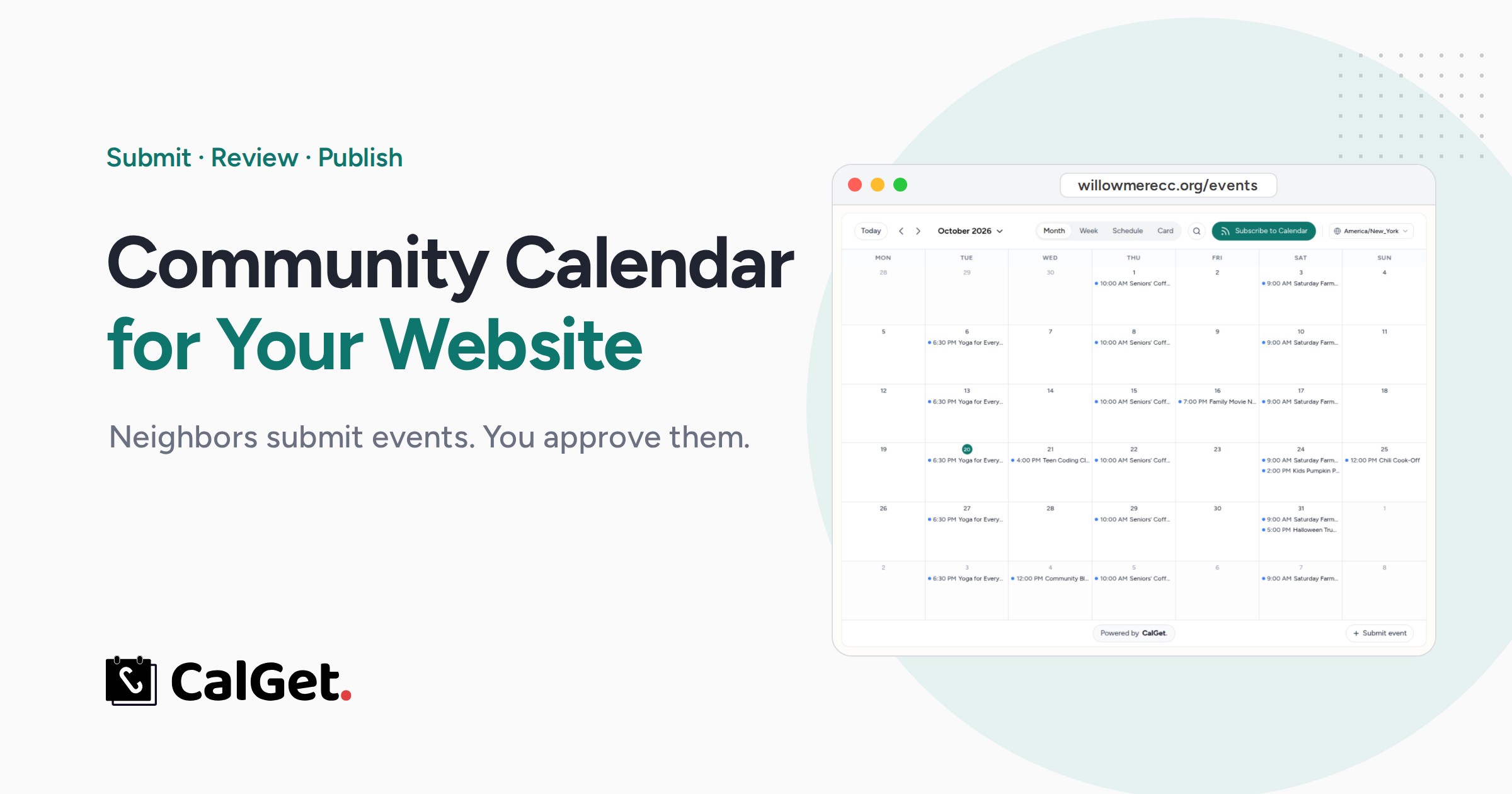
Last updated: October 2026. We set up a community calendar for a made-up community center, put it on a demo website with the real CalGet embed code, and walked through a real event submission from a visitor's form to the calendar.
Quick answer
A community calendar for your website is a public events calendar that local groups and neighbors can add events to, usually after you approve them. To set one up without building anything:
- Create one calendar for your community's events in CalGet and add your own.
- Open the calendar's Guest Events tab and click Enable guest submissions.
- Put the calendar on your website with Accept guest events turned on, so visitors get a Submit event button.
- Review each submission under Pending, then click Review & approve to publish it, or Reject.
If you run the events page for a town, a library, a chamber of commerce or a community center, you know the emails. "Can you add our bake sale?" "Is there room on the calendar for the garden club?" Each one turns into a copy-and-paste job: read the email, find the date, type it into the website, check the time zone, hit publish. Miss one, and someone wonders why their event never showed up.
A community calendar with submissions turns that around. People send their events through a form on your website, the details arrive complete and in one place, and nothing goes live until you've had a look. This guide shows how to set one up, what submitters see, how approving works, and the rules that keep a public calendar useful.
What is a community calendar?
A community calendar is a shared, public list of local events, from classes and markets to meetings and fundraisers, that more than one group contributes to. Unlike a single organization's events page, other people can suggest events for it, and an editor approves them before they appear.
Cities, libraries, chambers of commerce, community centers, churches, neighborhood associations and local news sites all run them. The City of Sacramento, for example, publishes a community calendar submission guide for groups that want their events listed. The hard part is rarely the calendar itself. It's collecting events from lots of people without retyping every one.
Three ways to run a community calendar
- A contact form, and you copy events in by hand. It's cheap to set up, but every submission becomes data entry, details go missing, and the calendar falls behind whenever you're busy.
- A dedicated community calendar platform. Built for cities and media companies, with lots of features. Often more than a library or a neighborhood group needs.
- A calendar with submissions built in. Visitors fill in the event themselves, in the same fields a calendar uses, and you approve it with one click. This is what we'll set up with CalGet below.
How to create a community calendar for your website
We set this up for the made-up Willowmere Community Center on October 21, 2026. Every screenshot is real.
Step 1: Create the calendar and add your own events
In CalGet, click Calendars, then New Calendar, and give it a name people will recognize, like "Willowmere Community Calendar". Add your own events first, so the calendar isn't empty on day one. If your events already live in Google Calendar or Outlook, sync that calendar from the External Calendars tab instead of retyping them.
Step 2: Turn on guest submissions
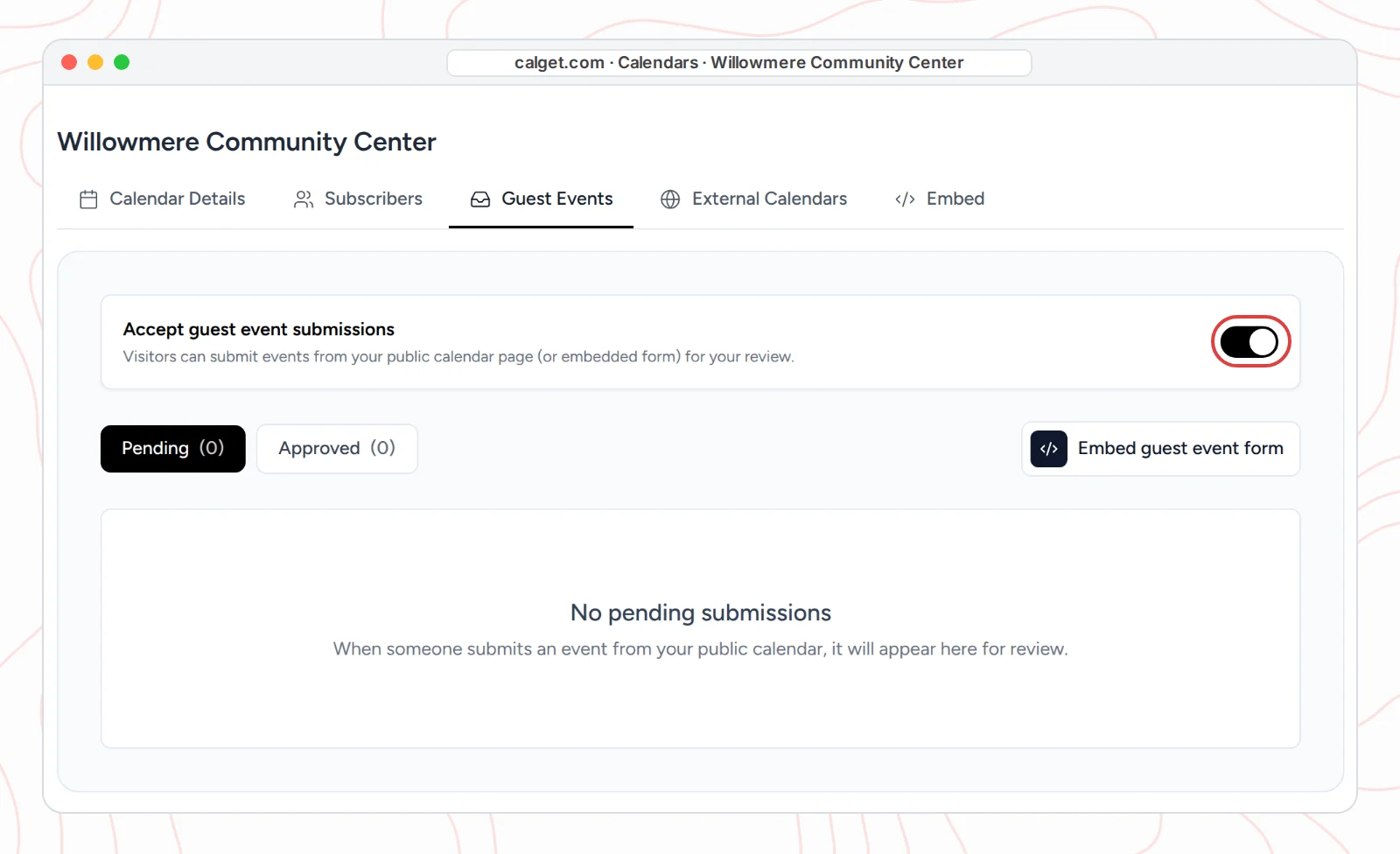
Open your calendar and click the Guest Events tab. Click Enable guest submissions. You'll see "Guest event submissions enabled", and the Accept guest event submissions switch is now on. New submissions will wait under Pending.
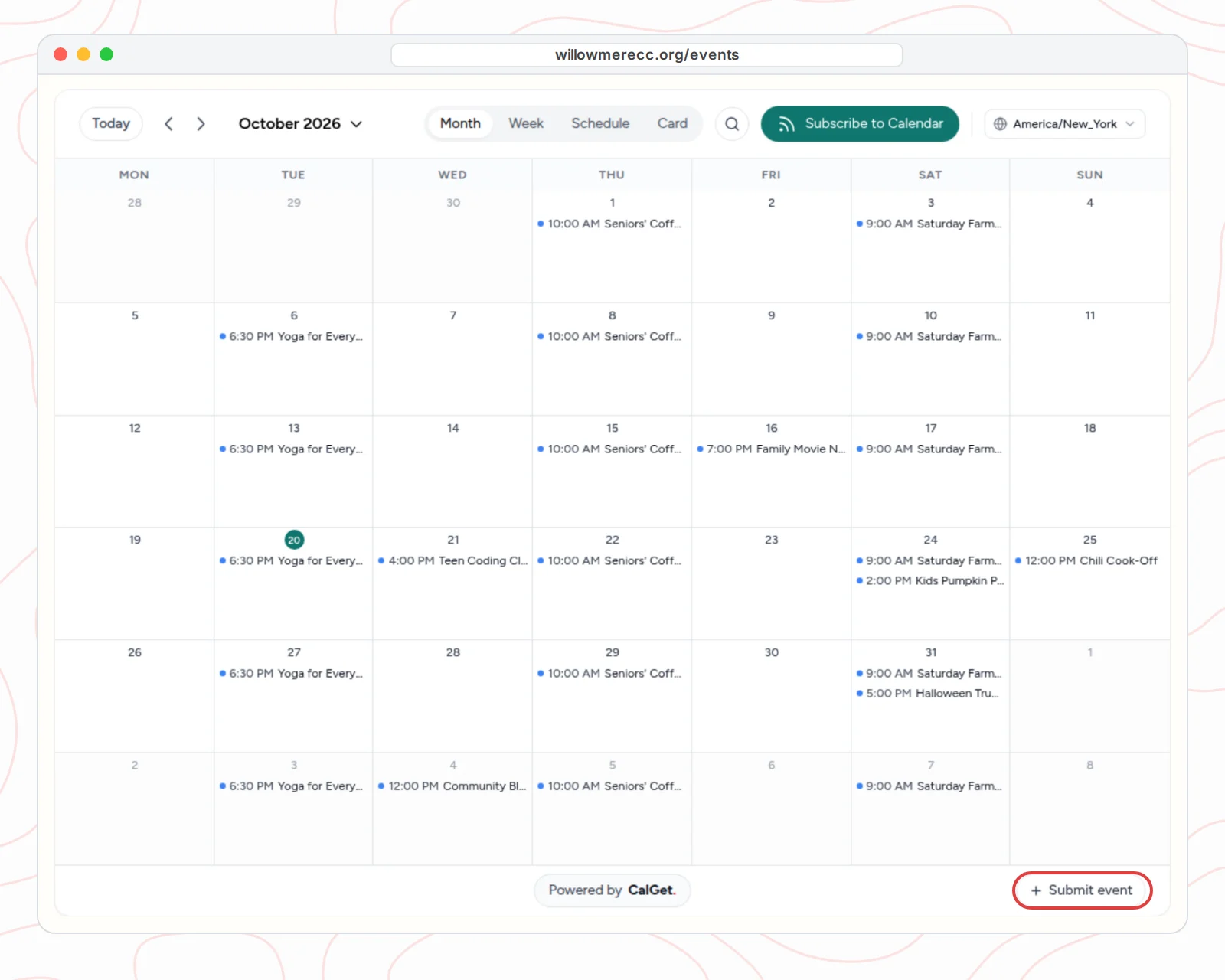
With this on, your calendar's own public page also shows a Submit event button next to Upcoming Events, so you can share that link even before your website is ready.
Step 3: Put the calendar on your website with "Accept guest events" on
Click Embeddable Calendar in the sidebar and pick your calendar at the top right. Choose your colors and view, then open the toolbar's more options (the ⋯ button) and turn on Accept guest events: "Lets visitors submit events to the calendar for review."
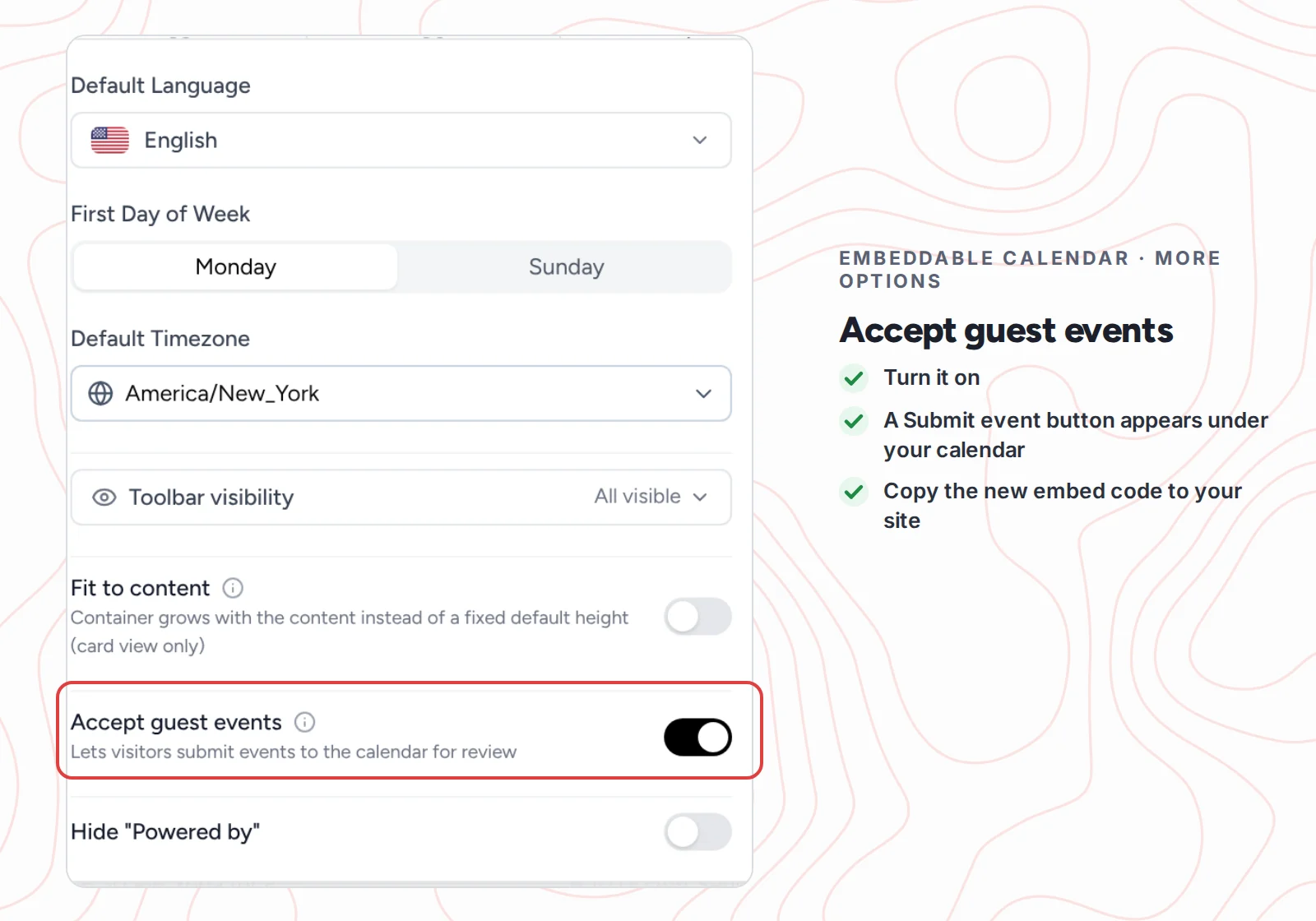
Click Get embed code, choose JS Embed and click Copy code. With the option on, the code includes data-accept-guest-events="1". Paste it into your website, allow your website's domain under Domains, and your calendar now has a Submit event button. Our guide to adding an events calendar to any website covers the pasting and domain steps for WordPress, Wix, Squarespace, Shopify and Google Sites.
Step 4: What people see when they submit an event
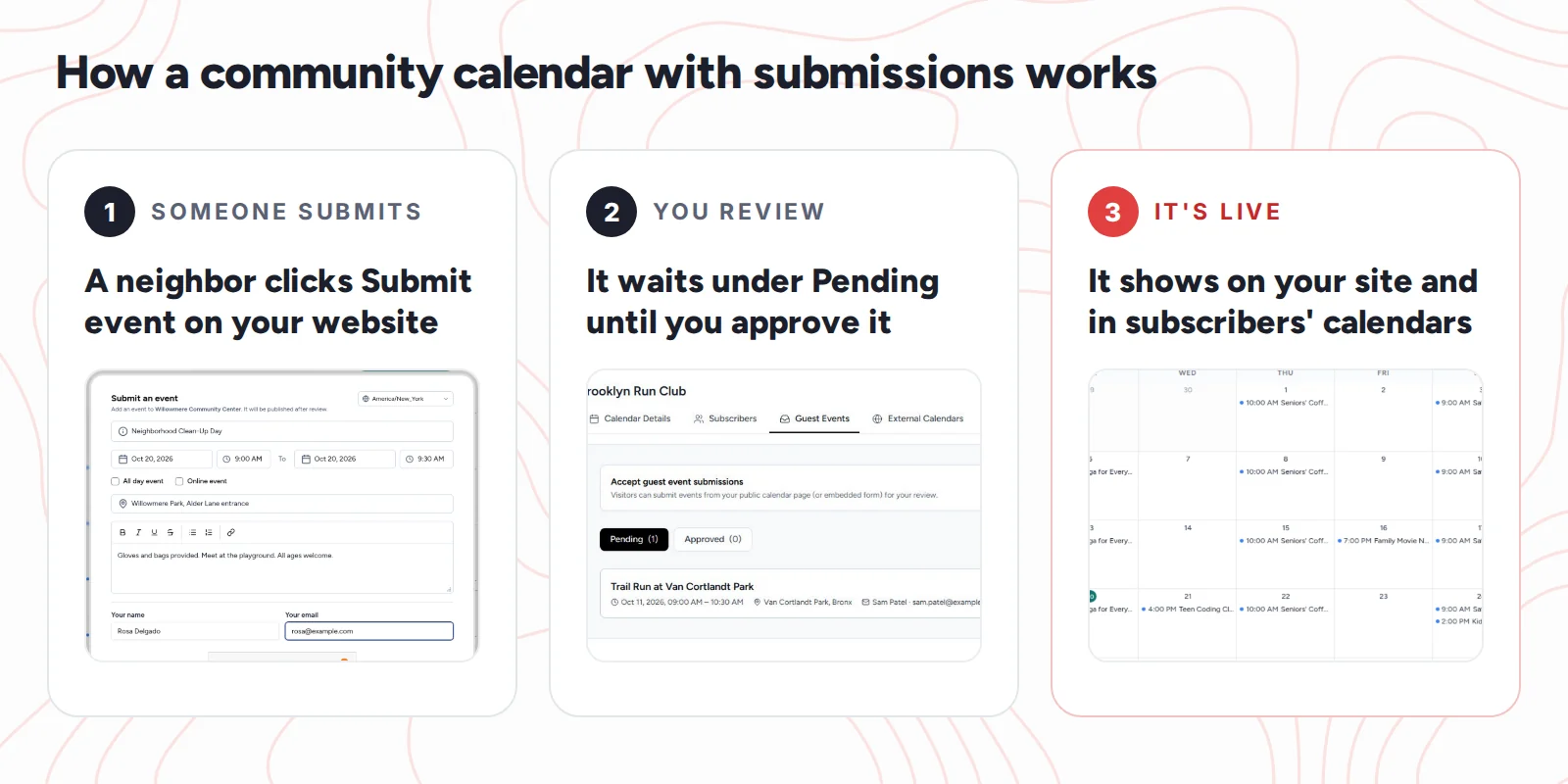
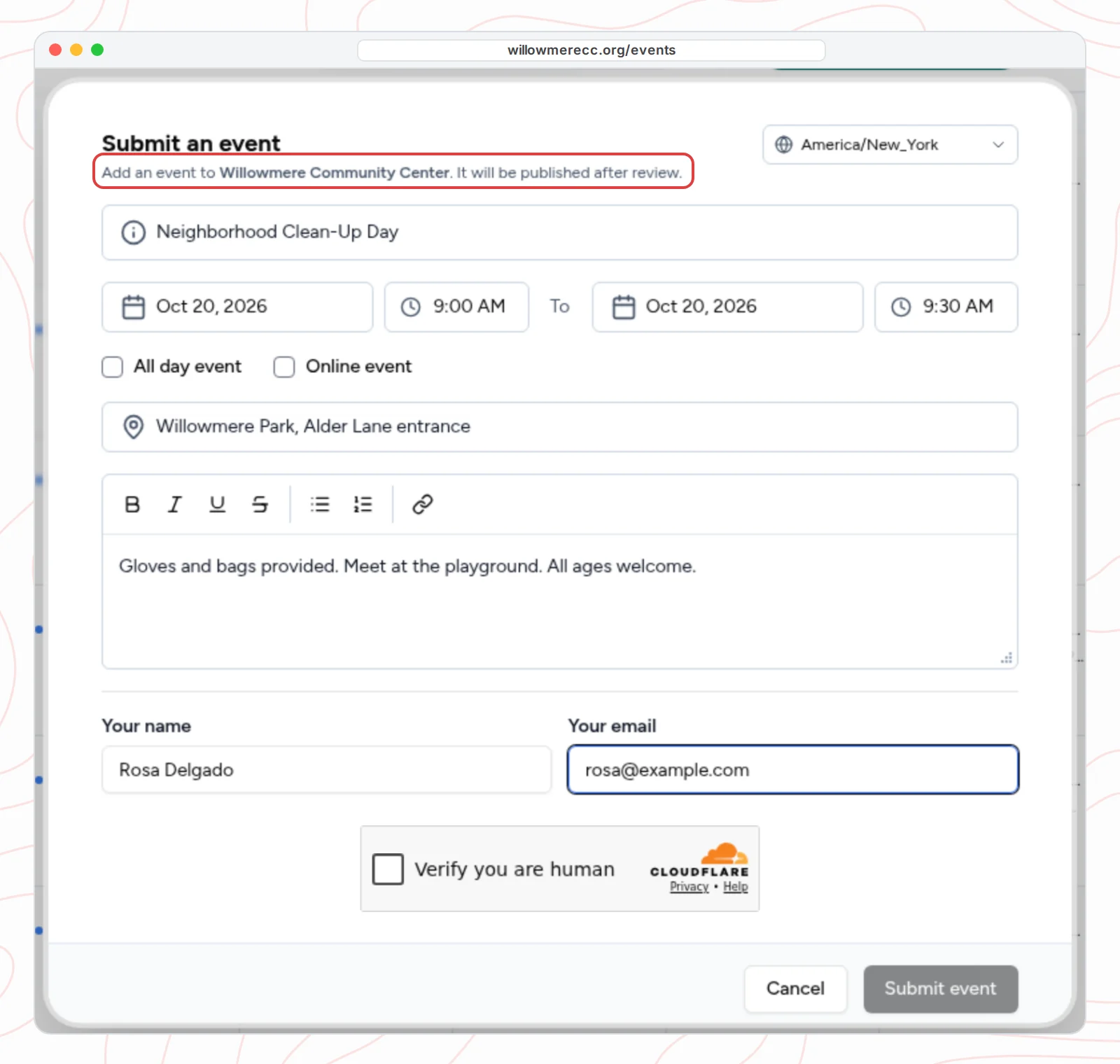
A visitor clicks Submit event and a Submit an event form opens right on your page. It asks for the event title, the date and time, whether it's all day or online, the location and a description, plus the submitter's name and email. The form tells them up front that the event "will be published after review", and a short security check runs before they can send it, which keeps spam out.
Step 5: Review and approve submissions
Each submission appears under Pending on the Guest Events tab, with its title, date, location and who sent it. You have two buttons: Reject, if it doesn't belong on your calendar, or Review & approve.
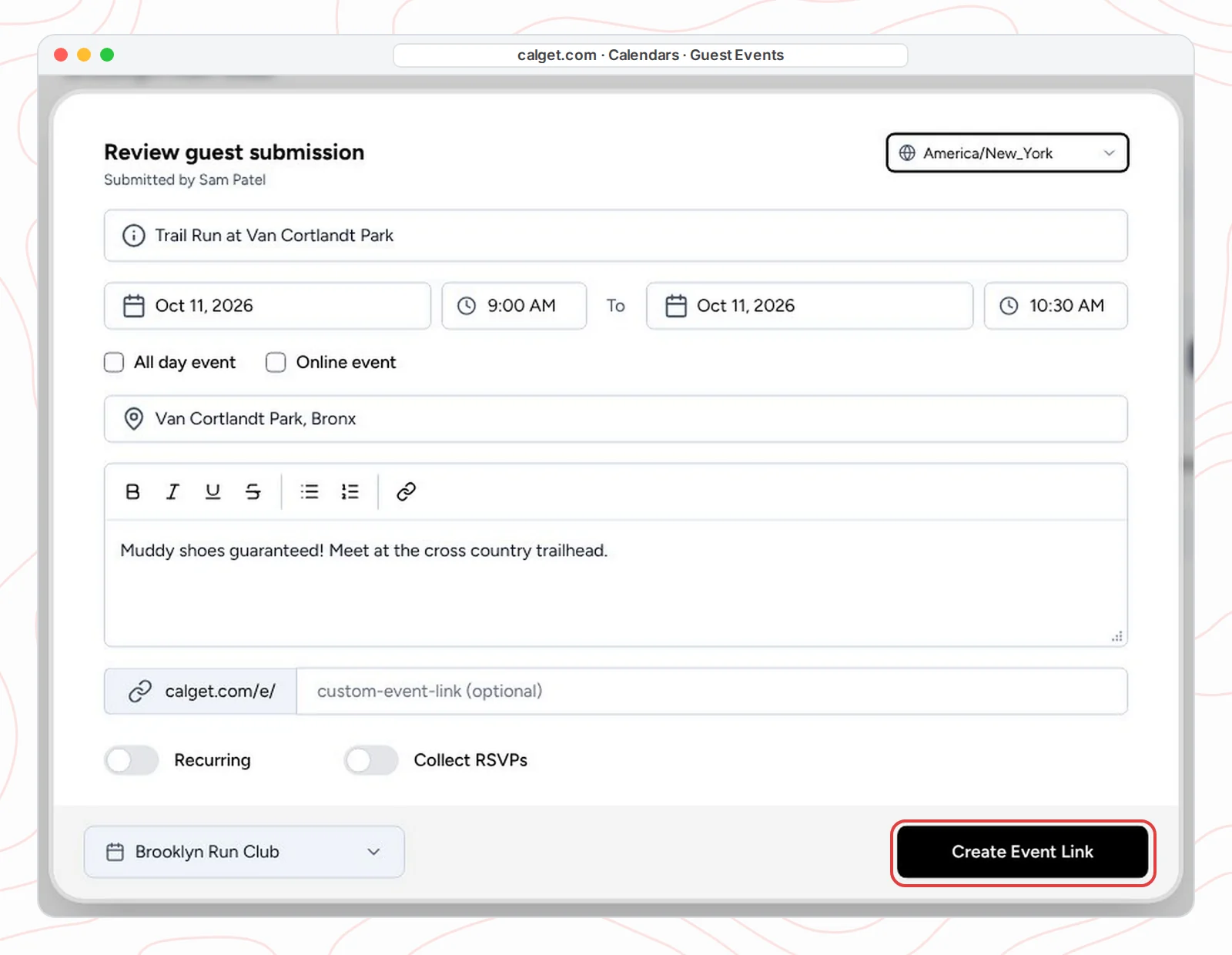
Review & approve opens Review guest submission: the same form you use for your own events, filled in with what the person sent. Fix a typo, tidy the title, add a link or turn on RSVPs, then click Create Event Link. CalGet shows "Guest event approved and published", and the event moves to Approved.
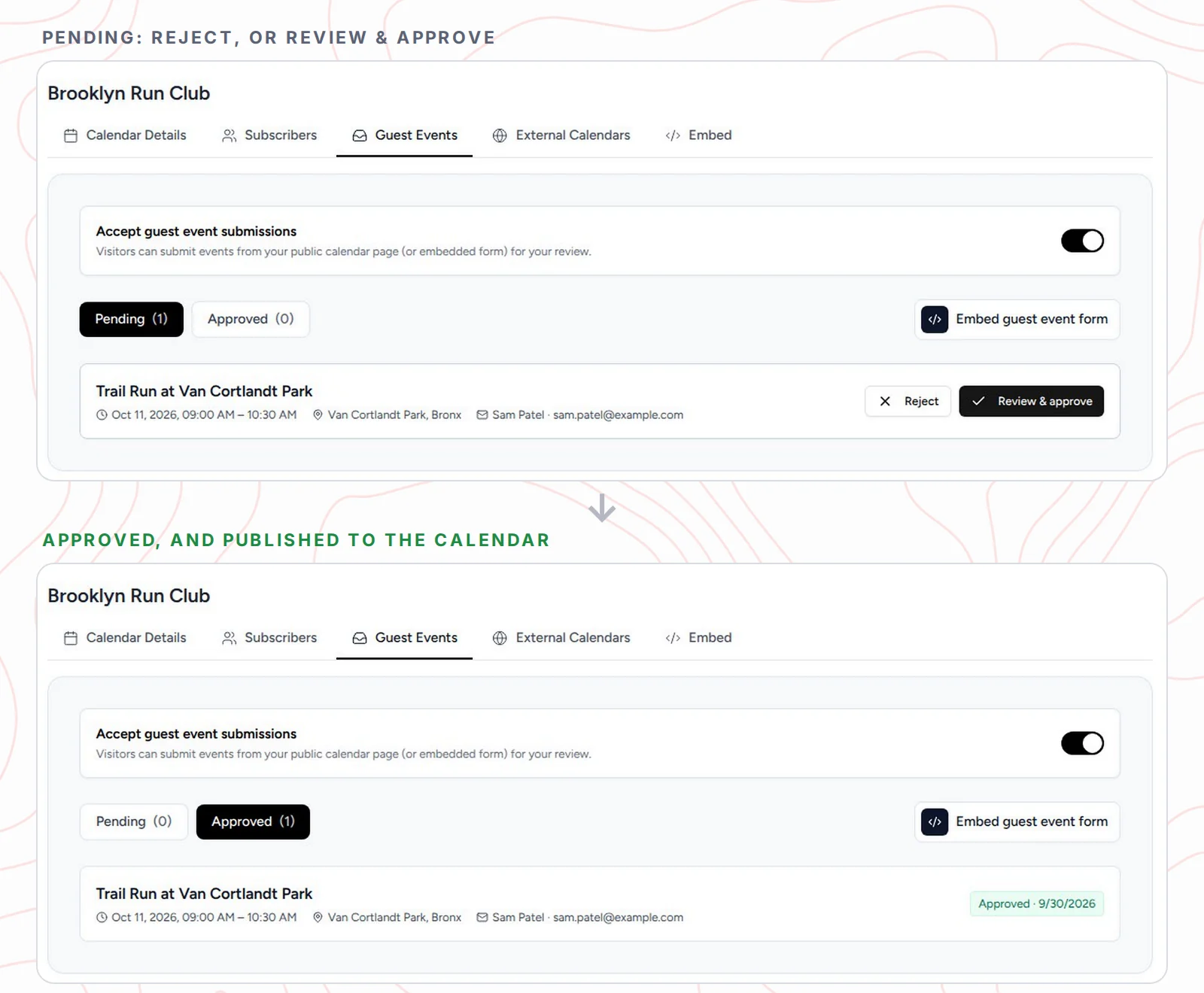
Once approved, it's a normal event on your calendar. It appears in the widget on your website, and everyone who subscribed to the calendar gets it in their own calendar app on its next refresh.
Optional: a submission form on its own
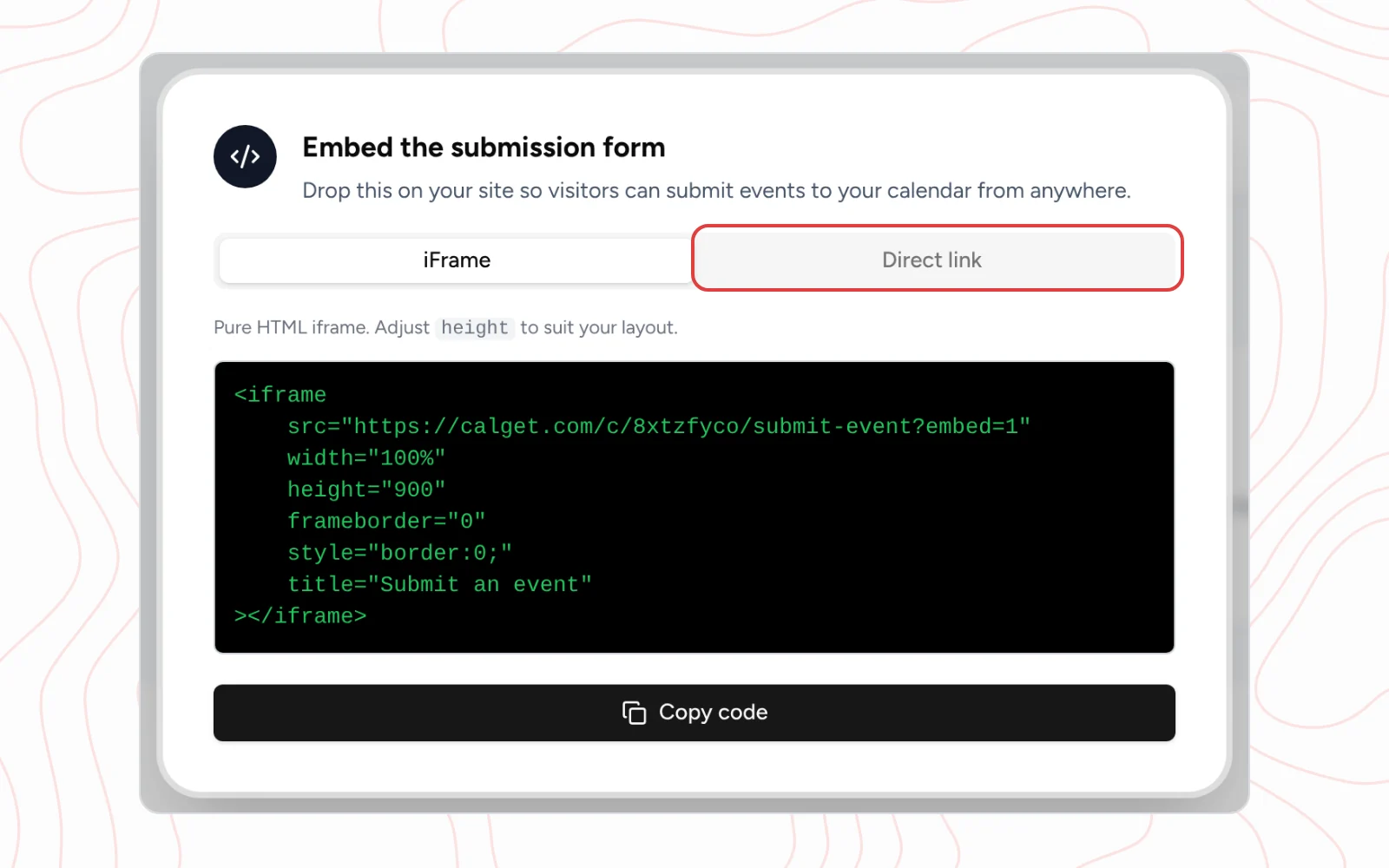
Want a "Submit your event" page, or a link in your newsletter? On the Guest Events tab, click Embed guest event form. Choose iFrame to paste the form into any page, or Direct link to share it anywhere.
Set submission rules before you open the door
A community calendar is only as good as what's on it. Cities that run them publish simple rules, and it's worth writing yours on the page next to the calendar. Here's a starting point to adapt:
- Who and where: events held in your town or neighborhood, by local groups, open to the public.
- What's in: classes, meetings, markets, fundraisers, volunteer days, performances.
- What's out: private parties, sales pitches, and anything that's mostly an ad.
- Timing: submit at least a week ahead, so you have time to review.
- Details: a clear title, the full address, and a contact person for questions.
- Your say: you may edit titles and descriptions for length and clarity, and you may decline any event.
Tips for a community calendar people actually use
- Check Pending on a schedule. Pick one or two days a week. Submitters stop sending events if they never appear.
- Keep titles consistent. "Farmers Market" every week, not "market!!" one week and "Sat. Mkt" the next. Review & approve lets you fix titles before they go live.
- Seed it yourself. A calendar with your own recurring events on it looks alive, and people are more likely to add theirs.
- Let people follow it. The widget's Subscribe to Calendar button lets residents get every approved event in Google, Apple or Outlook. Here's more on how subscription calendars work.
- Share the form outside your website. Put the direct link in your newsletter, your social profiles and your group chats: "Have an event? Submit it here."
How we tested this
On October 21, 2026, we turned on guest submissions for the made-up Willowmere Community Center calendar in CalGet, turned on Accept guest events on the Embeddable Calendar page, copied the real JS Embed code and pasted it into a demo community center website served at www.willowmerecc.org in a test browser. We opened the Submit event form there and filled it in with a made-up event, but didn't send it: the form's security check is built to stop automated browsers, and we didn't try to get around it. The pending submission, the Review guest submission window and the approval come from a real submission we made earlier on our made-up Brooklyn Run Club calendar and approved in CalGet. The steps match CalGet's help article on letting visitors submit events with Guest Events.
Frequently asked questions
How do I make a community calendar for my website?
Create one calendar for your community's events, turn on guest submissions so people can send events in, and embed the calendar on your website with a Submit event button. In CalGet, that's the Guest Events tab plus Accept guest events on the Embeddable Calendar page. You approve every event before it appears.
Can people submit events to my calendar without an account?
Yes. In CalGet, submitters fill in a form with the event details plus their name and email. They don't need a CalGet account, and a short security check stops automated spam.
Do submitted events go live right away?
No. Every submission waits under Pending until you click Review & approve and then Create Event Link. You can also reject it. The form tells submitters the event will be published after review.
Can I edit a submitted event before approving it?
Yes. Review & approve opens the full event form with everything the person sent. Change the title, time, location or description, add a link, or turn on RSVPs, then publish it.
Where do approved events show up?
Everywhere the calendar does: on your website, on the calendar's own public page, and in the calendar apps of everyone who subscribed to it.
Can I collect submissions without putting a calendar on my website?
Yes. On the Guest Events tab, click Embed guest event form to get the form as an iFrame for any page, or as a direct link you can share in a newsletter or on social media.
A community calendar works when adding an event is easy for your neighbors and quick for you. Let people submit their own events, keep the final say, and the calendar fills itself. When you're ready, create your community calendar in CalGet and turn on guest submissions. See more of what the embeddable calendar can do on your website.

Written by the CalGet team
Updated October 2026 · Tested on a real CalGet calendar: guest submissions on, embedded on a demo website, a real submission approved
We build calendar tools for sharing events with lots of people, from sports clubs and schools to nonprofits. People at organizations like Harvard, Save the Children and OGC Nice use CalGet to get events into their audience's calendars.

“Great Add Event to Calendar platform. Easy to create events and add them to emails and websites. Support responds quickly to questions and provides clean and concise answers. Highly recommended.” Foto Guy, on Trustpilot
Get Your Events on Everyone's Calendar.
Generate universal "Add to Calendar" links that work everywhere. Perfect for social media, emails, and websites.


Written by
Yared