Back to Blog
How to Add an RSVP Button to Your Mailchimp Emails (2026)
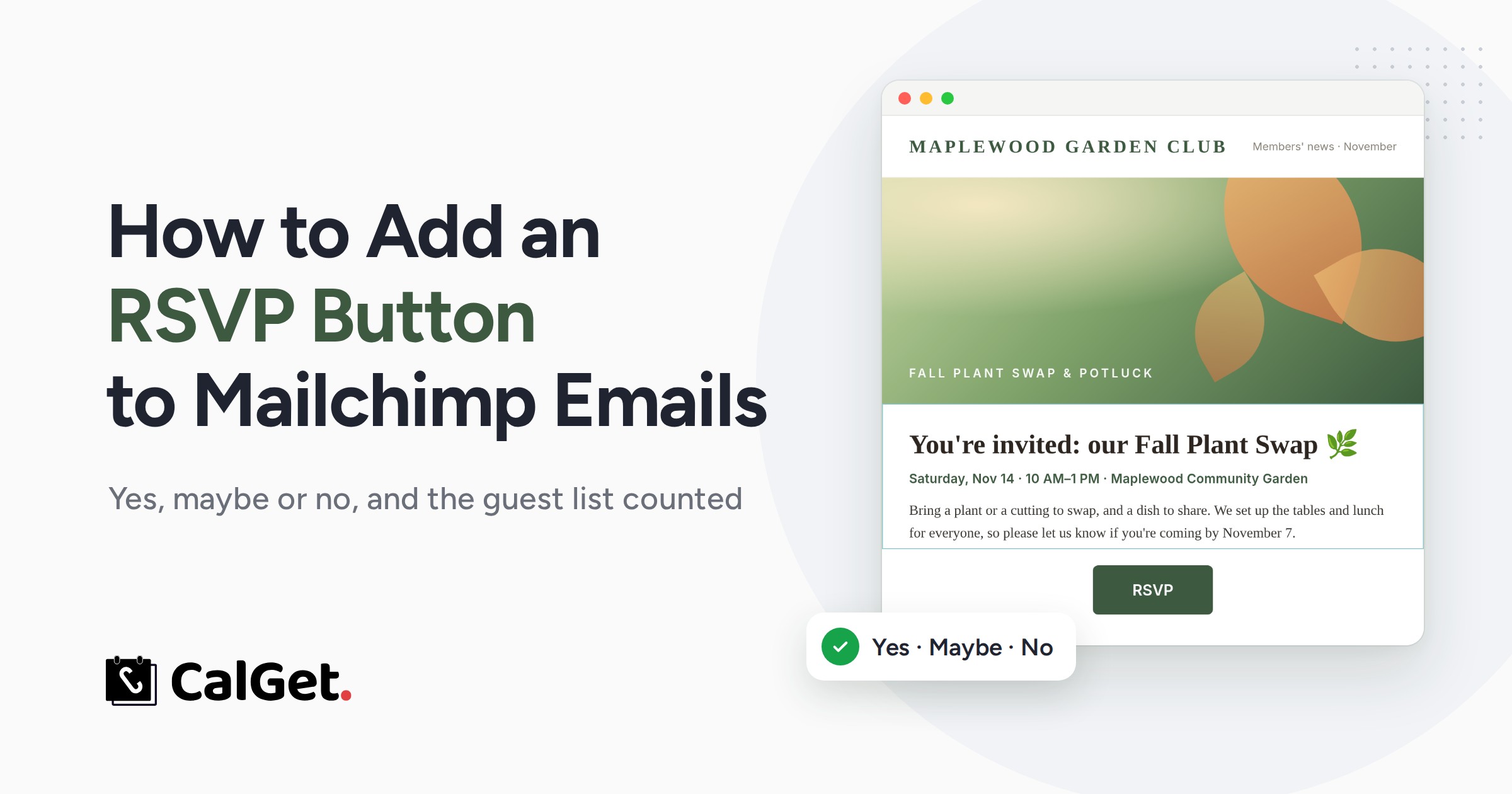
Mailchimp doesn't have an RSVP button, so event invites come back as replies you count by hand. Here's how to add a real RSVP button to any Mailchimp email, what your members see, and how to tell which RSVPs came from the email.
Written by
Last updated: October 2026. Every CalGet step below was tested on a real event in October 2026, and the Mailchimp steps follow Mailchimp's own help center.
Quick answer
Mailchimp doesn't have an RSVP button, but you can add one in a few minutes. Create your event in CalGet with Collect RSVPs turned on and copy the event link. In Mailchimp's email builder, drag a Button block into your email, set the text to RSVP, keep Link to: Web address and paste the link. Members tap it, answer Yes, Maybe or No, can add the event to their calendar, and you get the guest list, counted for you.
You send the newsletter on Monday: "Fall Plant Swap, Saturday the 14th, please let us know if you're coming." By Wednesday your inbox has "Yes!", "Two of us", "Maybe?", "Can't make it, sorry", and a dozen more, scattered between everything else. Somebody has to read them all, keep a tally, and hope nobody replied to the wrong thread.
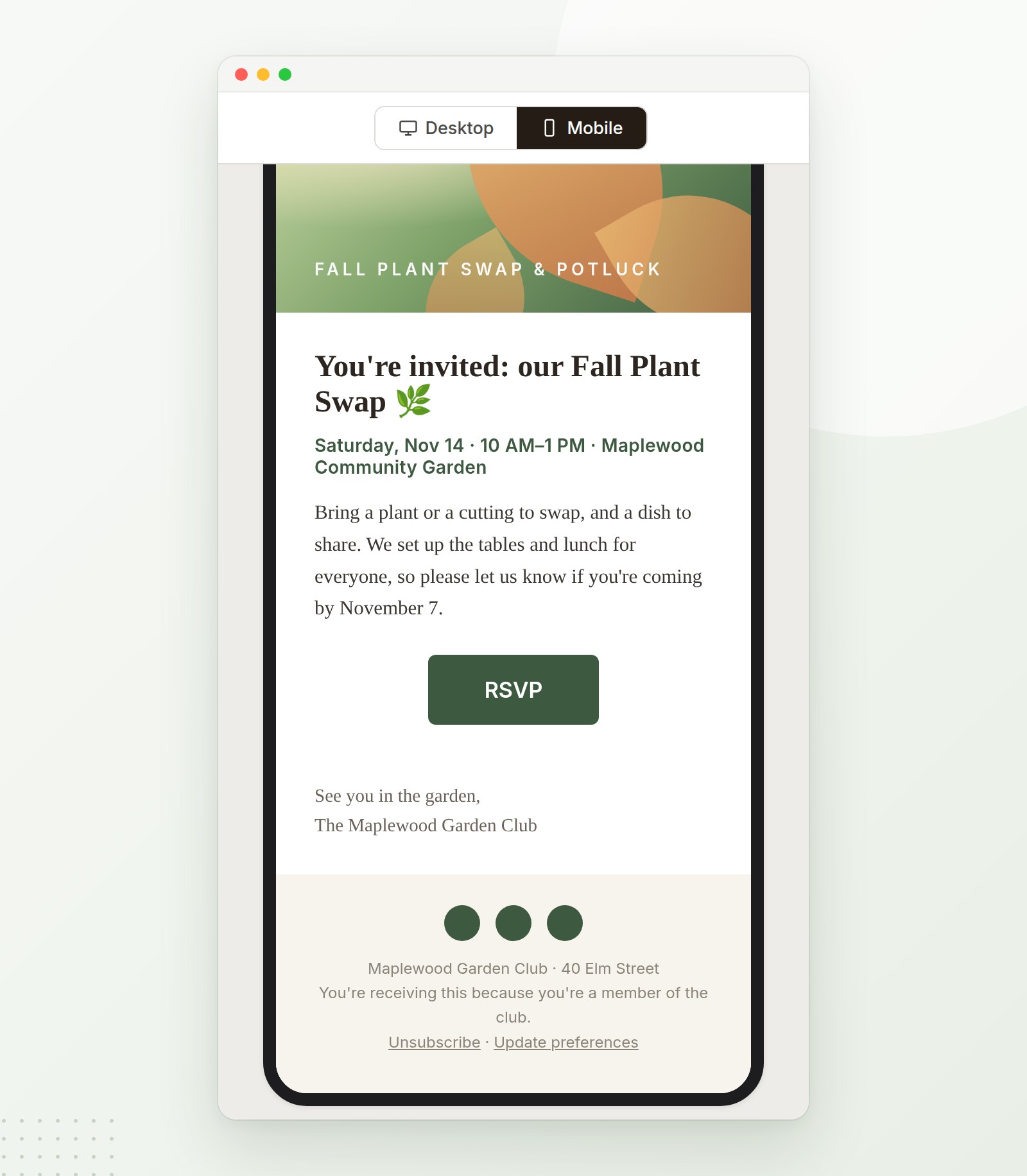
An RSVP button fixes that. This guide shows you how to add an RSVP button to any Mailchimp email, step by step, using a real event we built for a small garden club. You'll see what your members see on their phones, where the answers show up, and how to tell exactly how many RSVPs came from the email.
Prefer to watch? The whole setup takes under three minutes on video.
Does Mailchimp have an RSVP button?
No. Mailchimp's email builder has blocks for text, images, buttons, products, surveys and more, but there's no RSVP block and no event guest list. The closest thing is the Survey block, which, as Mailchimp's guide to Survey blocks explains, adds a button that links to one of your Mailchimp surveys.
A survey can ask "Are you coming?", but it's built for questions, not events. It won't show people the date and place next to their answer, and it can't put your event in their calendar. That's why the usual answer is a regular Button block that links to an RSVP page.
| "Reply to this email" | Mailchimp survey | RSVP button to a CalGet page | |
|---|---|---|---|
| Answer in one tap | No, they write a reply | Yes | Yes: Yes, Maybe or No |
| Event details on the answer page | Only in the email | Only what you type into the survey | Date, time and place, built in |
| Add to their calendar | No | No | Yes, right after they answer |
| Guest list | You count by hand | Survey responses | Counts, names and emails, deadline, limit, export |
New to the term itself? Our guide on what RSVP means covers the etiquette side.
How to add an RSVP button to a Mailchimp email
Here's the whole process at a glance. Each step is explained below.
- 1Create the event in CalGet with Collect RSVPs turned on.
- 2Copy the event link. That's your RSVP page.
- 3Add a Button block in Mailchimp and paste the link.
- 4Tag the link so you can see which RSVPs came from the email (optional).
- 5Preview on mobile and send yourself a test.
Step 1: Create the event in CalGet, with RSVPs on
In CalGet, click New Event. Add the title, the date and time, the place, and a short note for your guests. If you have a reply-by date, put it in the note too ("Please RSVP by November 7"). Then turn on Collect RSVPs and click Create Event Link.
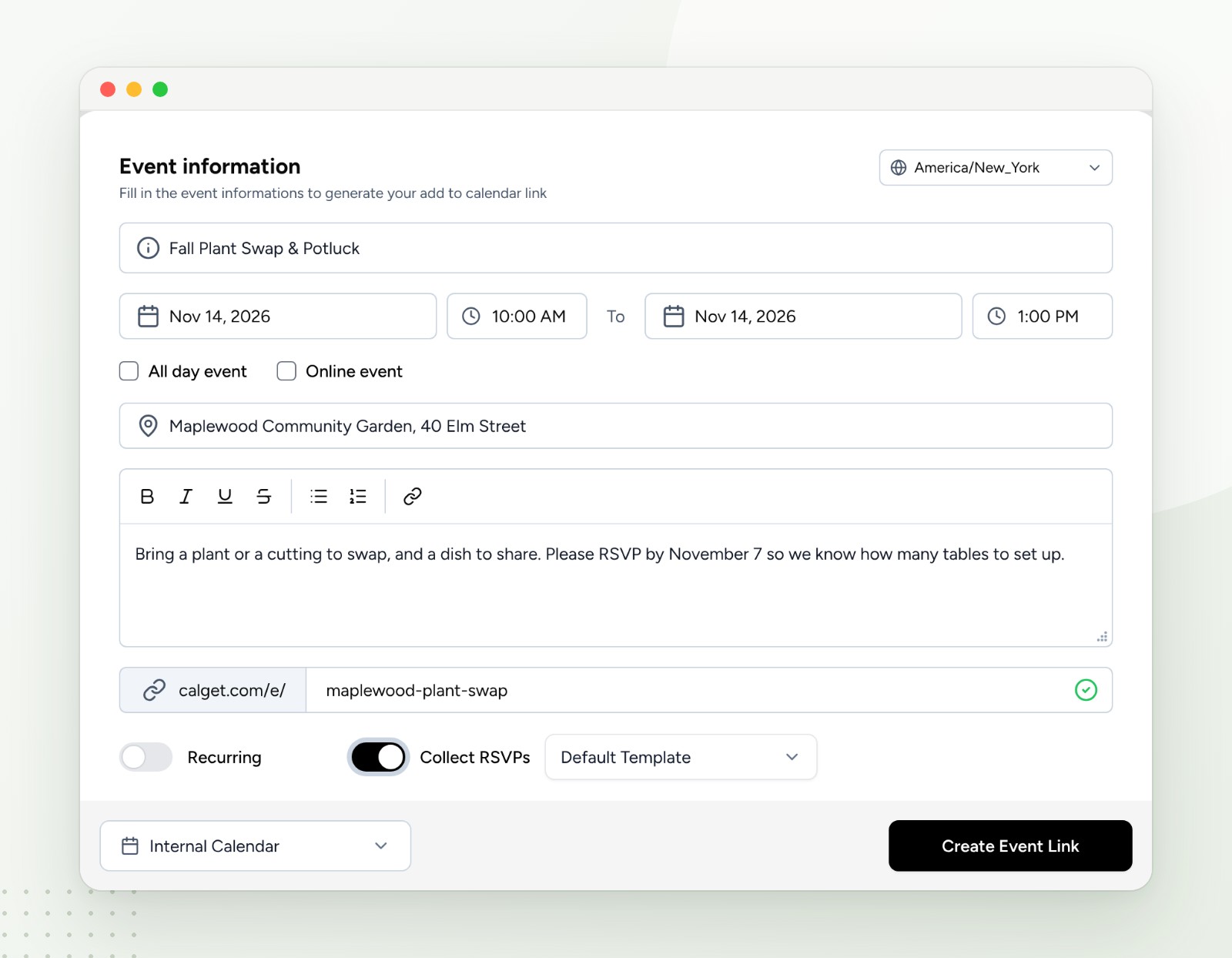
The custom link field is optional. Leave it empty and CalGet makes a short link for you; fill it in and you get a link people can read, like calget.com/e/maplewood-plant-swap.
Step 2: Copy the event link
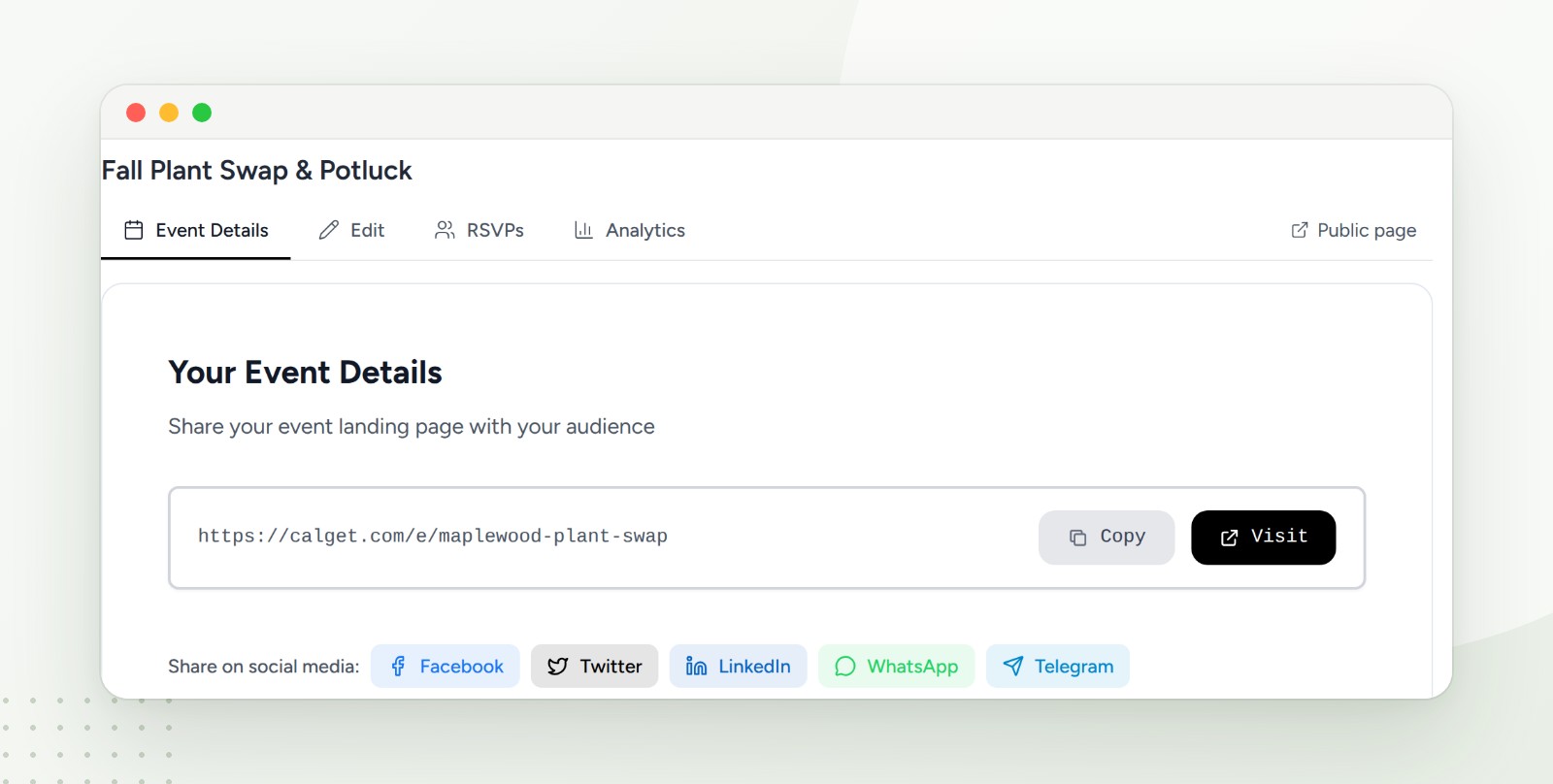
Open the event and you'll see Your Event Details with the event's link and a Copy button. That link is your RSVP page. It's the same link for everyone, so you can also use it on your website, in a text message or on social media.
Step 3: Add a Button block in Mailchimp and paste the link
Open your email in Mailchimp's builder. Then:
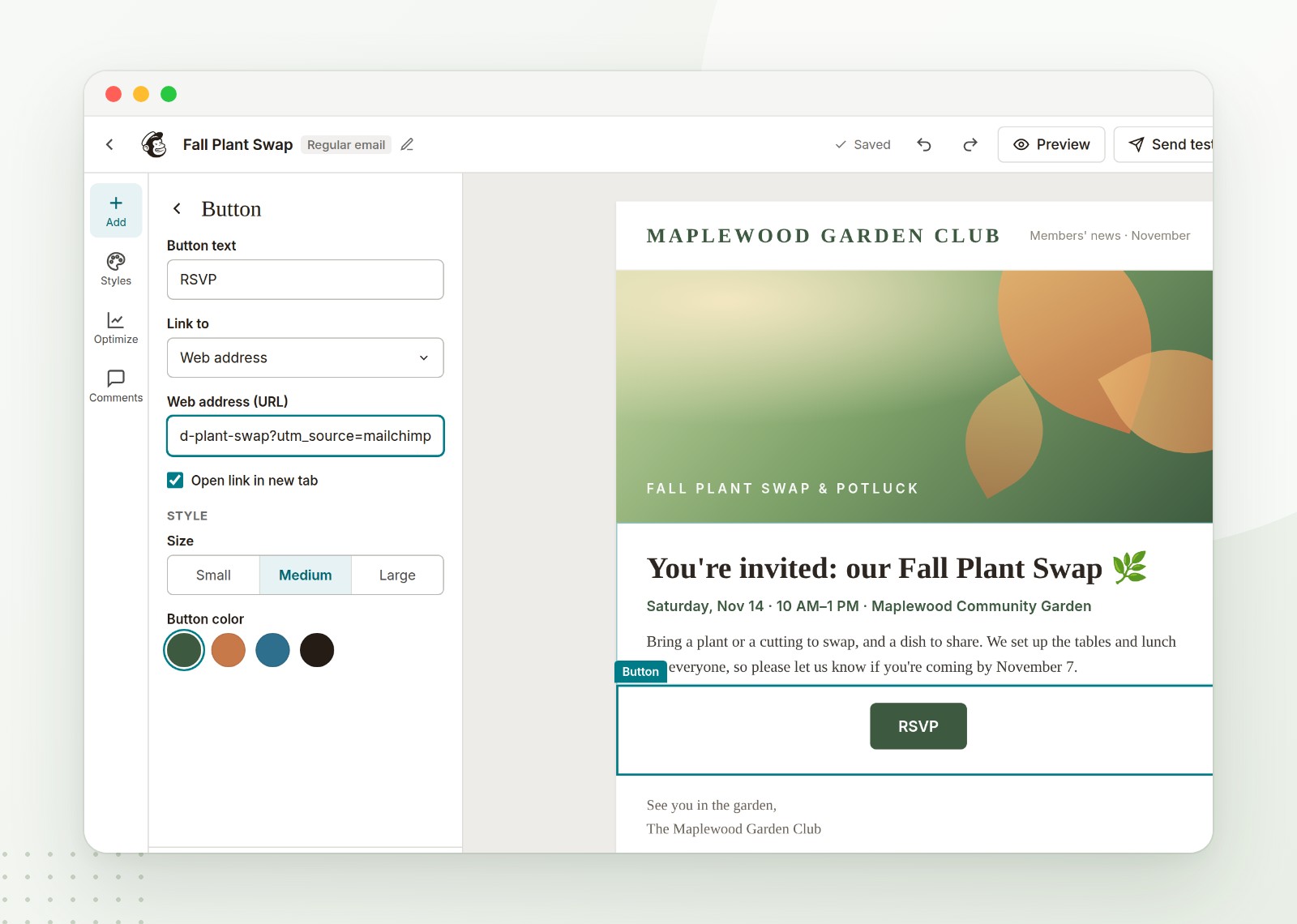
- Drag a Button block from the Add panel into your email, right under your invitation text.
- Change the button text to RSVP.
- Leave Link to on Web address, which is the default.
- Paste your CalGet link into the web address field. Mailchimp needs the full address, starting with https://.
- Keep "Open link in new tab" checked if you want the page to open in a new tab.
You can then style the button: Mailchimp lets you set its alignment, shape, size, border, colors and padding, and even use different sizes on desktop and mobile. All of this is in Mailchimp's guide to Button blocks in the new builder.
Using the classic (legacy) builder?
The idea is the same: add a Button block and link it to a web address. The panels look different, so Mailchimp keeps a separate guide to Button blocks in the legacy builder.
Step 4: Tag the link so you know which RSVPs came from the email
This step is optional, and it's the one most guides skip. Add a small tag to the end of the link before you paste it:
https://calget.com/e/maplewood-plant-swap?utm_source=mailchimpThe part after the question mark is a UTM tag. It doesn't change the page people see. It just tells CalGet where the visit came from. Later, in the event's Analytics, the UTM Parameters tab shows how many RSVPs came in with that tag. We go through it under "See who's coming" below.
Sharing the same event in more places? Give each one its own tag, like ?utm_source=facebook for a Facebook post, and you'll see which one worked best.
Using Google Analytics tracking in Mailchimp?
If you've turned on Google Analytics link tracking for the email, Mailchimp adds its own UTM tags to your links, and Mailchimp itself warns that combining its tracking with custom UTM tags "could skew results in reports" (Mailchimp's guide). If you use both, send yourself a test and check the link the button opens before the email goes out.
Step 5: Preview on mobile and send yourself a test
Most people will see your email on a phone, so click Preview and switch to Mobile to check the button is easy to spot and easy to tap. Then use Send test to send the email to yourself, open it on your phone and tap RSVP once. It should open your event page, not your CalGet dashboard.
What your members see when they tap RSVP
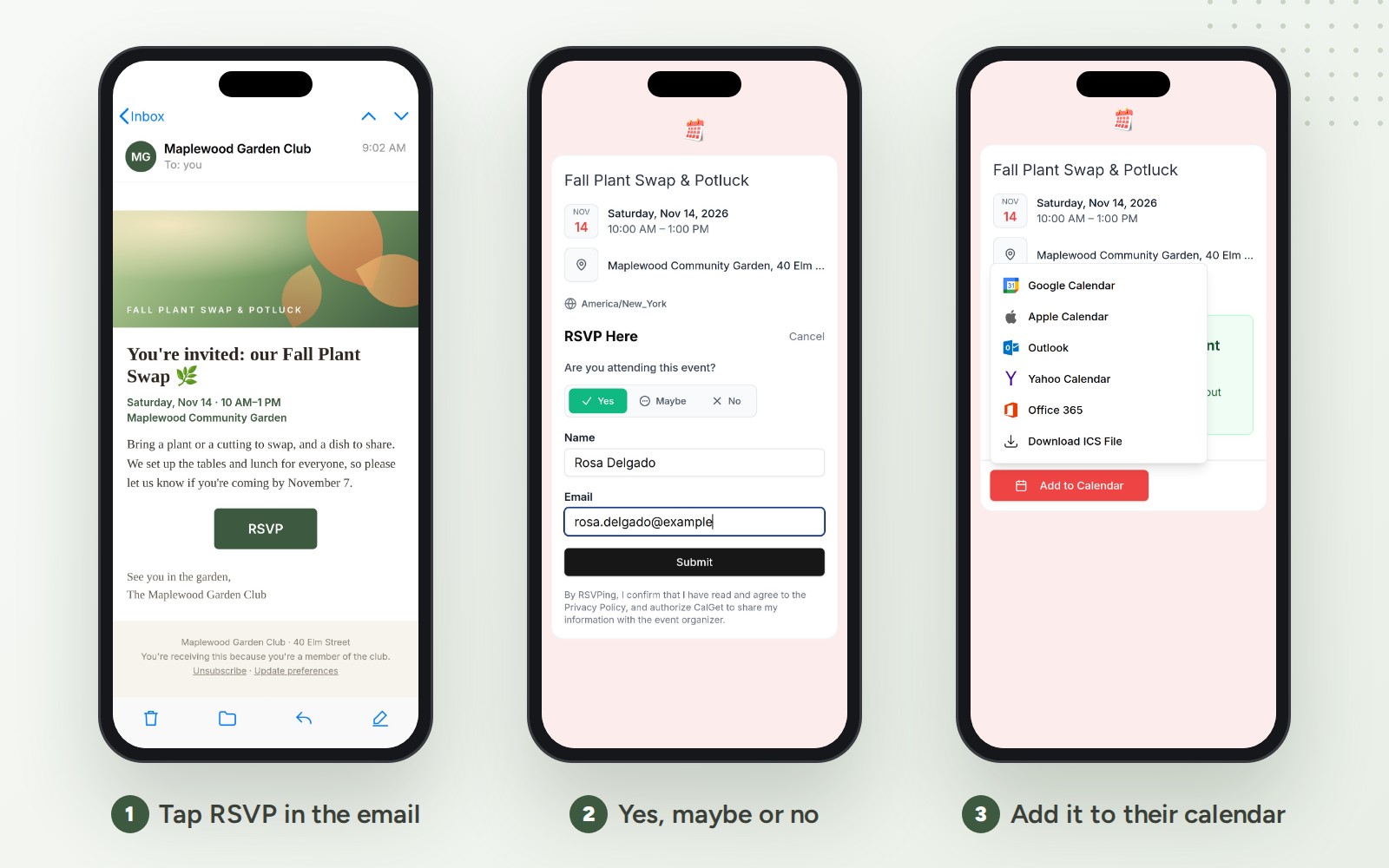
The button opens your event page, with the title, date, time and place at the top. Members tap RSVP, pick Yes, Maybe or No, and add their name and email. That's the whole form. Right after they answer, they see "You're attending" and an Add to Calendar button for Google Calendar, Apple Calendar, Outlook, Yahoo, Office 365 or a calendar file, so the plant swap ends up in their calendar instead of their inbox.
Want to send only the calendar step, without collecting answers? That's a different setup, covered in our guide to adding an Add to Calendar link to Mailchimp emails.
See who's coming, and which RSVPs came from Mailchimp
Back in CalGet, open the event's RSVPs tab. The counts are at the top: Attending, Maybe and Not Attending. Below them is the full list, with each person's answer, name, email and the time they replied.
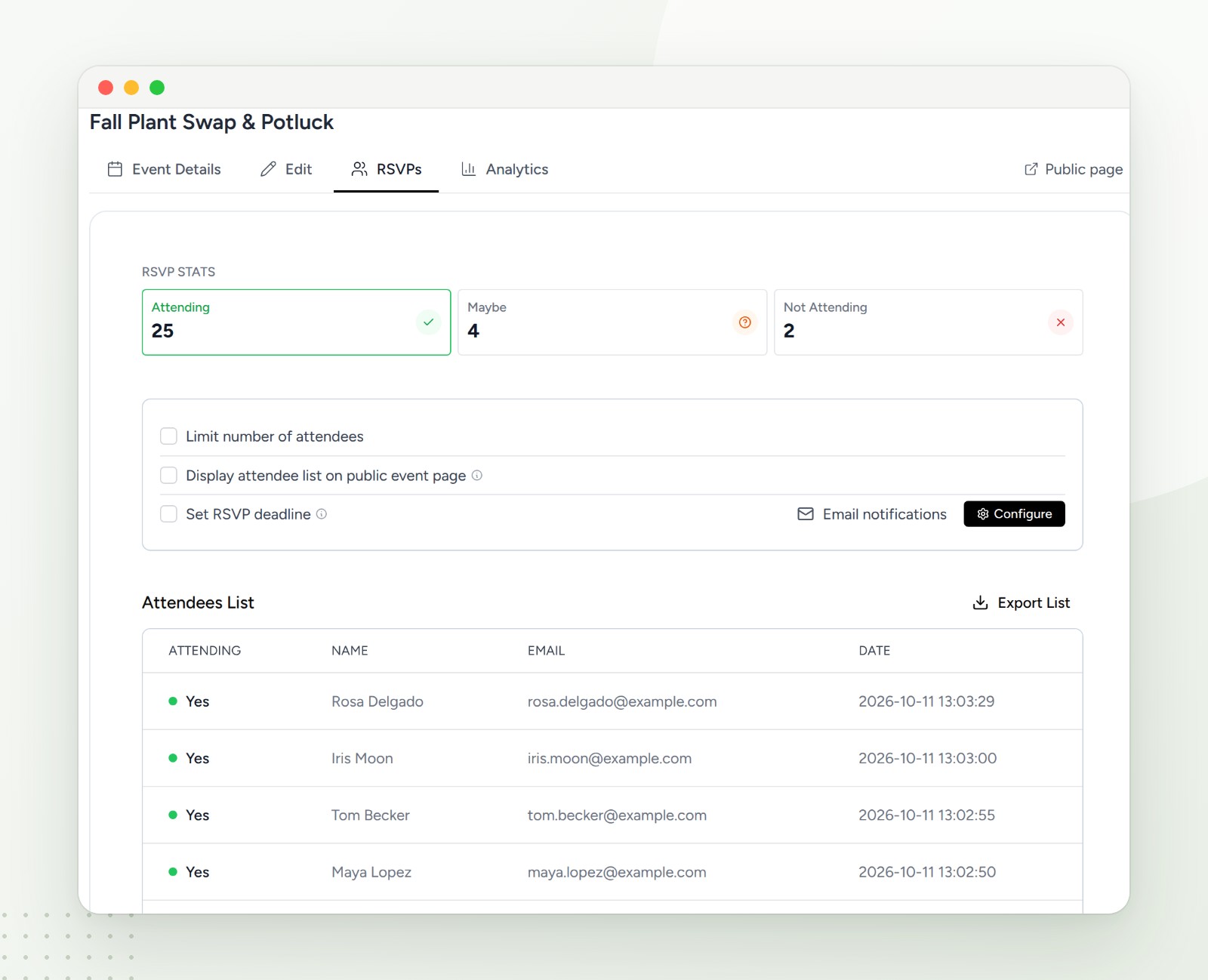
The same tab has the settings most clubs end up needing:
- Set RSVP deadline: the last day people can answer. Match it to the date in your email.
- Limit number of attendees: for when the room, the tables or the bus only fit so many.
- Display attendee list on public event page: lets members see who else is coming.
- Email notifications: get an email when someone RSVPs.
- Export List: download everyone as a CSV file (name, email, answer and date), ready for a spreadsheet, name tags or a follow-up email.
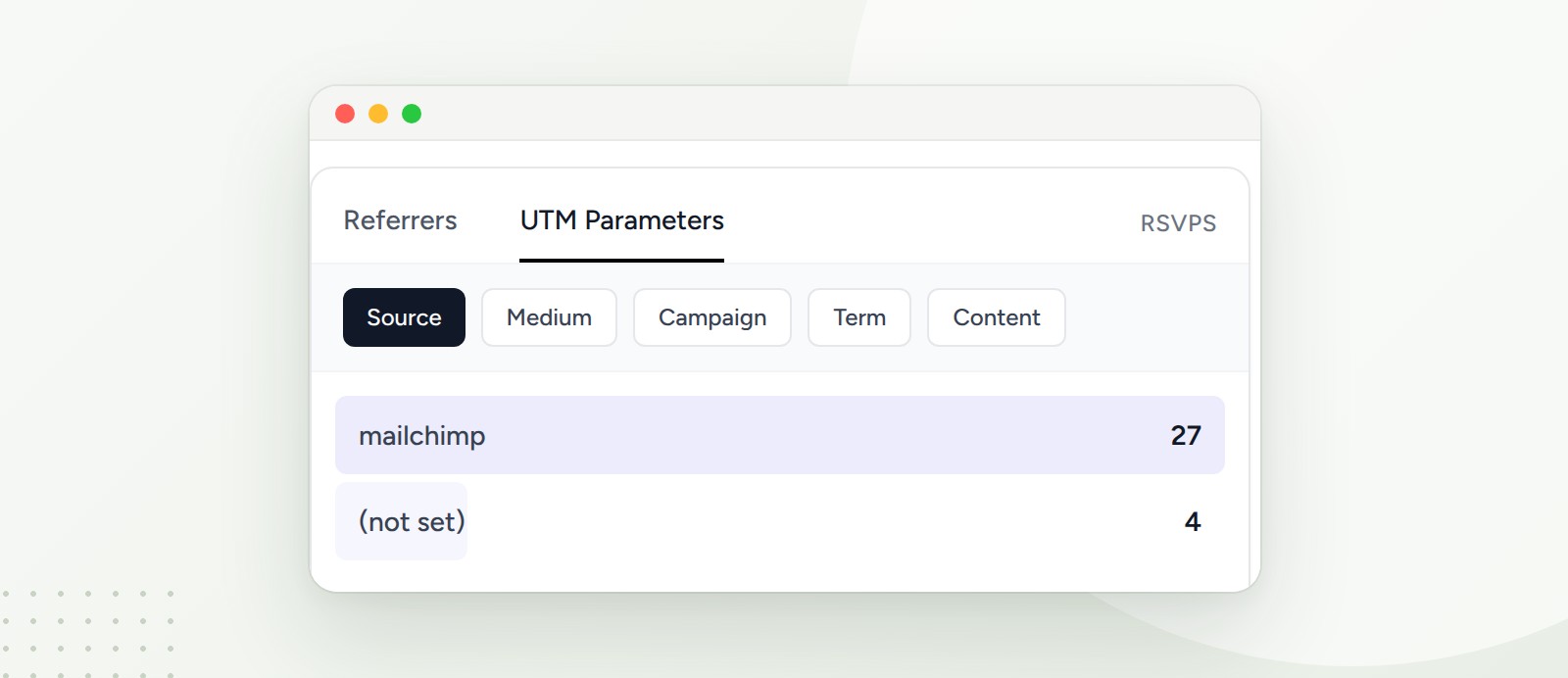
If you tagged the link in step 4, open the event's Analytics tab, then UTM Parameters. Under Source, you'll see how many RSVPs came in through the email's tag. In our test, 27 of the 31 RSVPs came from the Mailchimp email, and the other 4 came straight to the page.
More on these options in our guide to collecting RSVPs with CalGet.
Tips for an RSVP email people actually answer
Put the button where the decision happens. Right under the date, place and one line about the event. If people have to scroll past three sections to find it, many won't.
Use one button, not two. You don't need a separate "Add to Calendar" button next to RSVP. The RSVP page offers Add to Calendar right after they answer, so one button does both jobs.
Say the deadline in the email, and set the same one in CalGet. "Please RSVP by November 7" in the email, and November 7 under Set RSVP deadline. Then the email and the page never disagree.
Keep the button text short. "RSVP" is clear and fits on every phone. If you want more, "RSVP by Nov 7" still fits.
Reuse the link. Put the same event link in your reminder email, on your website and in your group chat. Every answer lands in the same list, and the tags tell you which channel worked.
Common mistakes
Pasting a link without https://. Mailchimp asks for a full web address. Copy the link with CalGet's Copy button and you'll have the whole thing.
Linking the wrong page. The RSVP link starts with calget.com/e/. A link to your CalGet dashboard only works for you.
Forgetting Collect RSVPs. Without it, the page shows your event but no RSVP form. Check the switch before you click Create Event Link.
Only testing on a computer. Send a test, open it on your phone and tap the button. That's how most of your members will see it.
How we tested this
We created a real CalGet event, "Fall Plant Swap & Potluck", with Collect RSVPs on and the custom link calget.com/e/maplewood-plant-swap. We sent 31 real RSVPs through the live page from different browsers with made-up names: 27 through the link tagged ?utm_source=mailchimp and 4 straight to the page. We checked the counts, the list, the deadline, the export file and the UTM report in CalGet, and RSVP'd ourselves on a phone, through to the Add to Calendar menu. The Mailchimp steps follow Mailchimp's help center as of October 2026.
The Maplewood Garden Club and its members are made up. The Mailchimp builder and the phone's mail app in the screenshots and the video are recreations, so your screens may look a little different; every CalGet screen and the RSVP page are real.
Key takeaways
- Mailchimp has no RSVP button; its Survey block links to a survey, not an event page.
- Create the event in CalGet with Collect RSVPs on, and copy the event link.
- In Mailchimp, add a Button block, keep Link to: Web address, and paste the full link.
- Add ?utm_source=mailchimp to the link to see how many RSVPs came from the email.
- Members answer Yes, Maybe or No and can add the event to their calendar; you get the counts, the list and an export.
Frequently asked questions
Does Mailchimp have an RSVP feature?
No. Mailchimp's email builder has no RSVP block or event guest list. You can add an RSVP button with a regular Button block that links to an RSVP page, like one made in CalGet.
Can I use a Mailchimp survey for RSVPs?
You can ask "Are you coming?" in a Mailchimp survey, and Mailchimp will collect the answers. But a survey isn't an event page: it doesn't show the date and place next to the answer, and it can't add the event to people's calendars. For events, an RSVP page does more with the same one click.
How do I add an RSVP link to a Mailchimp email?
Copy your event's RSVP link, then in Mailchimp's builder add a Button block, set the text to RSVP, keep Link to: Web address and paste the full link, starting with https://. You can also link a word or a sentence in a text block to the same address.
How do I know how many RSVPs came from my Mailchimp email?
Add ?utm_source=mailchimp to the end of the link you put on the button. In CalGet, open the event's Analytics, then UTM Parameters, and the Source list shows the RSVPs that came in with that tag.
Can I limit the number of people who RSVP?
Yes. In the event's RSVPs tab in CalGet, turn on Limit number of attendees. You can also set an RSVP deadline there.
Does this work in other email tools?
Yes. The RSVP link works in any email tool that lets you add a button or a link. We have guides for HubSpot and Outlook, and for invitations designed in Canva.
Add an RSVP button to your next Mailchimp email
Create the event, copy the link, add a button. The next time you invite your list, the answers count themselves.
Create your RSVP page in CalGet and put it in your next newsletter.
Written by the CalGet team. We build the RSVP and calendar tools that clubs, nonprofits and event organizers use to get answers and get people to show up, and we tested every CalGet step in this guide ourselves.
Get Your Events on Everyone's Calendar.
Generate universal "Add to Calendar" links that work everywhere. Perfect for social media, emails, and websites.


Written by
Yared